Introducing Strada Signals, our new report series on AI for insurance operations. Read our whitepaper →
Introducing Strada Signals, our new report series on AI for insurance operations.
Read our whitepaper →
Introducing Strada Signals, our new report series on AI for insurance operations. Read our whitepaper →
Conversational AI in Insurance: A Complete 2026 Guide

Amir Prodensky
CEO
10 min read
A practical roadmap to faster service and happier policyholders
Why does insurance need conversational AI?
Let’s be honest: insurance has some frustrating pain points.
Customers sit on hold for too long. Calls get missed. Agents spend hours on manual data entry. The result? Delays, errors, and customers who feel ignored.
Now fast-forward to 2026. People expect instant answers, 24/7. If a policyholder has a question at midnight, they don’t want to wait until business hours. If they call during the day, they don’t want to be stuck in a queue.
They expect smooth, on-demand service, every time. That’s where conversational AI steps in. It solves the pain points that slow insurers down:
- Long hold times → AI handles routine calls instantly.
- Missed calls → AI ensures every call is answered.
- Manual data entry → AI captures and logs details automatically.
- Customer frustration → AI delivers fast, consistent responses.
Some companies are already proving what’s possible. For example, we at Strada position ourselves around “never miss a call again.” Our AI-powered voice agents enable you to answer 100% of calls, day or night.
That means carriers, MGAs, and brokers can stay available without burning out their teams.
When you remove friction from conversations, everyone wins. Customers feel heard and valued. Agents focus on the tough, high-value cases. Businesses save time and money.
With these challenges in mind, here’s how conversational AI is actually being applied across customer service, sales, and internal operations.
How is conversational AI used in insurance?
From customer calls to back-office tasks, conversational AI makes interactions faster, smoother, and more efficient.
Let’s look at where it delivers the most value.
| Area | What AI does | Benefit for insurers |
| Customer service | Provides policy details, verifies coverage, answers questions | Reduces hold times, improves satisfaction |
| Sales & Renewals | Qualifies leads, runs reminders, supports upsells | Higher conversions, more revenue |
| Quote intake | Captures customer info and logs into AMS/CRM | Saves agent time, prevents errors |
| Claims management | Guides customers through claim status, updates, and next steps | Faster resolution, better customer experience |
| FNOL capture | Captures first loss details, validates information, and routes to adjusters | Speeds up claim initiation, reduces costs |
General-purpose AI tools, like ChatGPT or cross-industry tools, need heavy customization.
Strada takes a different approach.
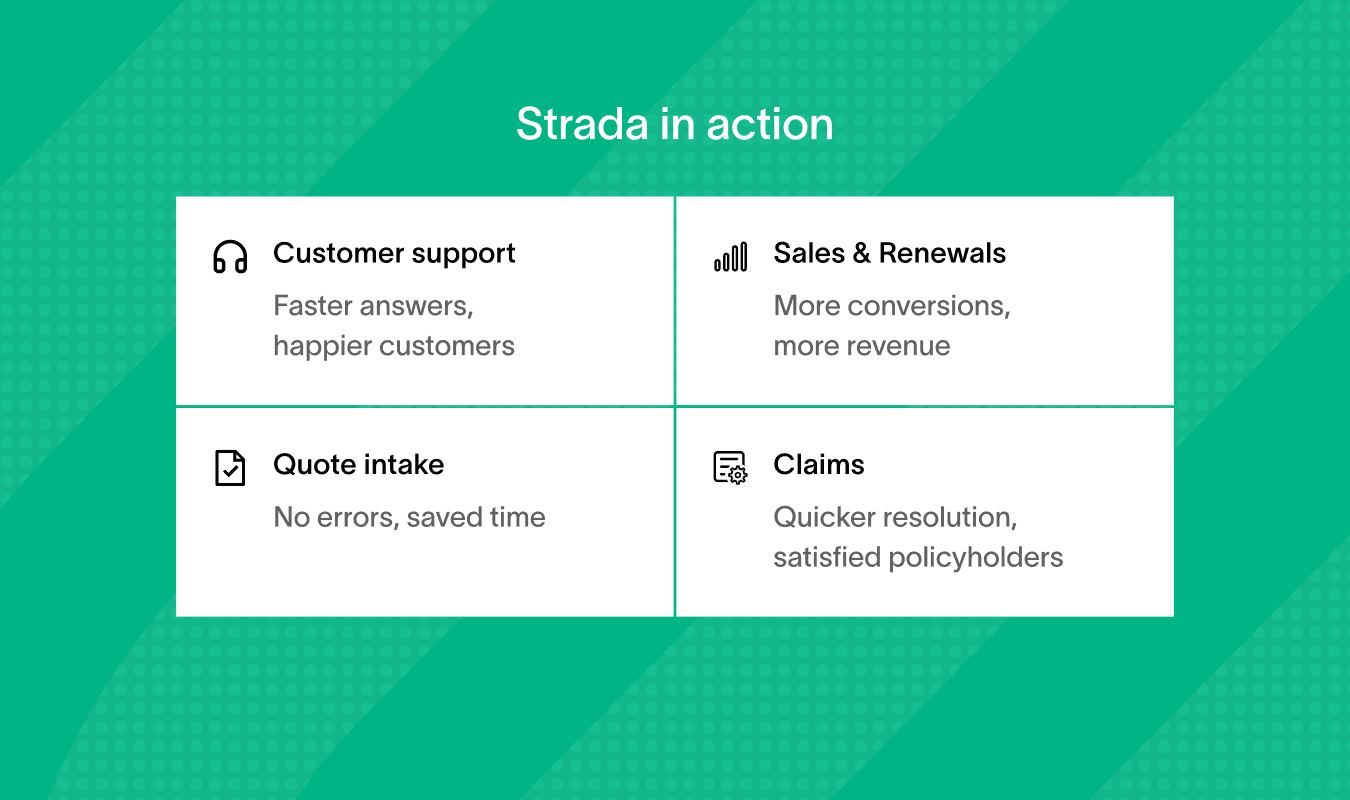
It comes with pre-built insurance-specific use cases: FNOL process automation, policy servicing, renewals, and quote intake. That means insurers can get started faster and see results quickly, without long setup times.
Seeing AI in action is useful, but what really matters is the difference it makes for customers, agents, and business outcomes.
What benefits do the best conversational AI for insurance applications bring?
The biggest reason insurers are adopting conversational AI is simple – it makes service faster, easier, and more reliable for both customers and agents.
To put it simply, conversational AI brings four key benefits:
| Benefit | How it helps | Real-world conversational AI insurance impact |
| #1 Growth | Smart lead follow-ups, renewals, and upsells | An agent misses fewer opportunities – e.g., Strada automatically follows up on a quote, leading to more policies renewed and higher revenue. |
| #2 Reliability | 24/7 coverage with consistent, accurate responses | A customer calling at midnight about a claim gets the right answer instantly |
| #3 Speed | Instant answers with zero hold times | Instead of waiting 10 minutes on hold, a customer gets help immediately, leaving them feeling valued and less frustrated. |
| #4 Efficiency | Scales without extra headcount | Strada can handle thousands of calls in a day (like processing auto accident or storm damage claims during peak season) without hiring more staff. |
For insurers, that’s not just an upgrade. It’s a competitive advantage.
Of course, every powerful tool comes with hurdles. So, let’s look at the main challenges insurers face when adopting conversational AI.
What are the main challenges?
If you’re in insurance, you know the stakes are high. You’re dealing with sensitive data, strict rules, and customers who expect a personal touch.
Here are the challenges that conversational AI can bring to the table:
- Privacy & Security → Policyholders share sensitive financial and personal details. A single data breach can ruin trust and damage your brand.
- Compliance → Insurance is tightly regulated. agentic AI in insurance has to follow the same rules as human agents: disclosures, record-keeping, everything. No shortcuts.
- Integration → Most carriers and brokers still use legacy AMS, PAS, CMS platforms. Connecting AI into these can be messy and, if done wrong, creates data silos or broken workflows.
- Human balance → Customers want speed, but they also expect empathy, especially during claims. AI should handle routine tasks, while humans step in for complex or emotional calls.
Our team at Strada is addressing these head-on. Our platform is SOC 2 Type 2 compliant, undergoes regular penetration testing and offers data isolation and privacy-first LLM usage. That means insurers can adopt AI with confidence, knowing security and compliance are built in.
To understand how these challenges are addressed, it helps to know the technologies behind conversational AI.
What technologies power conversational AI for insurance?
Conversational AI may feel like magic, but it’s really a mix of powerful technologies working together. Each piece plays a role in making conversations feel natural, useful, and fast.
Let’s break down the main ones you’ll see in insurance today.
1. Large Language Models (LLMs) for conversation
LLMs are the brain of voice AI. They take the words customers use and generate clear, natural responses in real time. Instead of sticking to rigid scripts, LLMs understand context, nuance, and phrasing.
This makes conversations feel more like talking to a person than interacting with a machine. In insurance, that means customers get answers that adapt to their situation, no matter if they’re reporting a claim, checking coverage, or asking a simple question.
2. Transcription and Speech Models for voice
Transcription and speech models handle the “voice” part of voice AI:
- Transcription (speech-to-text) turns spoken words into text that the AI can process.
- Speech generation (text-to-speech) turns the AI’s response back into a natural-sounding voice.
Together, they make real-time conversations possible. Customers can talk the way they normally do, and the AI responds instantly in a clear, human-like voice.
Without these models, voice AI would feel robotic and frustrating.
3. Generative AI for dynamic responses
This is where things move beyond simple scripts. Generative AI creates dynamic, context-aware responses instead of canned replies.
That means conversations can feel more natural, flexible, and engaging. In insurance, it also helps the AI adapt when a customer asks something unexpected.
4. Omni-channel integrations
Customers don’t stick to one channel. They might start on chat, switch to a phone call, and later get a follow-up email. Conversational AI needs to move with them.
Omni-channel integration ensures the experience is smooth across chat, phone, SMS, and email. No repeating information.
No dead ends.
And that’s where Strada stands out.
While many tools focus only on chat, Strada goes deep on phone-based AI agents. Calls are still the lifeblood of insurance, and Strada automates them without losing the personal touch. But it doesn’t stop there.
Strada agents can take live actions, like sending an SMS confirmation, emailing a document, transferring to a human agent, or scheduling a call.
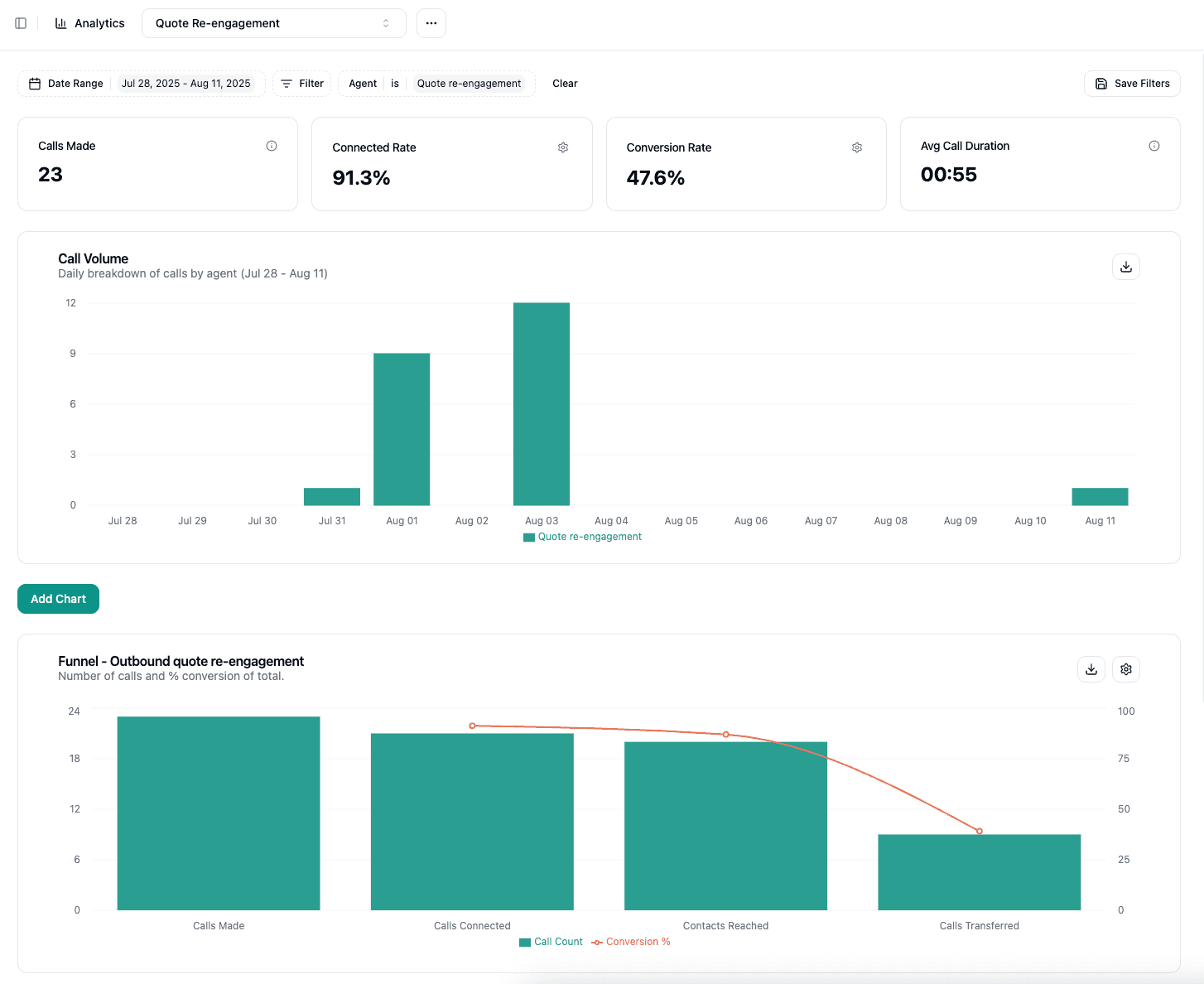
Even more, Strada integrates directly with insurance systems like AMS, Policy Admin, and Claims systems. That means data flows automatically, reducing manual entry and ensuring every conversation is tied to your existing workflow.
When you put these technologies together, you get something powerful: an AI that listens, understands, responds naturally, and connects across every channel. For insurers, that means more efficient operations, happier customers, and a future where conversations happen seamlessly, anytime, anywhere.
Still, technology is powerful, but in insurance, it’s constantly evolving. Let’s explore the trends that are driving conversational AI forward in 2026.
What are the latest trends in 2026?
Conversational AI in insurance isn’t standing still. In 2026, several clear trends are shaping how carriers and brokers use this technology.
If you want to stay ahead, here are the key developments to watch.
Voice-first insurance services
Phones remain the main way customers contact insurers, so voice-first AI is taking off fast. Instead of waiting on hold, policyholders can speak directly with AI agents who capture details, answer questions, and escalate when needed.
Strada leads in this space with phone-based AI that handles real conversations and even takes live actions, like sending SMS updates, emailing documents, or scheduling follow-ups. This approach is especially useful for claims and urgent inquiries.
Customers get quick answers, and human agents aren’t tied up with routine calls.
Hyper-personalized renewals and retention campaigns
Renewals have always been a challenge for insurers, but AI makes them smarter. In 2026, AI scoring models help identify which customers are most likely to lapse, letting insurers reach out with tailored campaigns.
Personalization goes beyond simply using a customer’s name. AI can suggest add-ons, highlight coverage updates, or adjust timing to match each policyholder’s habits.
The result is fewer lost policies, stronger loyalty, and higher conversion rates, all without extra work for your team.
AI copilots for agents
Insurance workflow automation isn’t here to replace humans. It’s here to help. AI copilots now support agents during complex calls by surfacing relevant policy information, suggesting next steps, and even taking notes in real time.
This frees agents to focus on empathy, problem-solving, and building trust – things machines can’t do. Customers get faster, more accurate service, and agents feel empowered rather than overwhelmed.
It’s a win-win for everyone.
Seamless integrations with insurance systems
Finally, AI works best when it connects smoothly with existing systems. In 2026, conversational AI should integrate directly with AMS, policy, and claims platforms.
This keeps data flowing, reduces double entry, and cuts errors. Teams can keep their familiar workflows while gaining AI-driven efficiencies.
Smooth integrations make adoption easier, and your AI solution becomes a real partner in everyday operations.
Together, these trends show where insurance is heading: faster service, more personalized engagement, smarter tools for agents, and stronger customer relationships. For insurers, the message is clear: conversational AI for insurance isn’t just a trend. It’s becoming the new standard for how insurance gets done.
Trends are inspiring, but seeing how insurers are actually using AI makes it real.
What are some real-world examples?
Insurance companies are already seeing real benefits from conversational AI.
Take us at Strada, for example. Together with Tint, we created an AI agent, “Aimee,” that works seamlessly alongside human teams.
Fernanda Soares, Senior Manager at Tint, explains, “Leveraging Strada as a foundation, we’ve created Aimee to complement our support team. It allows us to scale with confidence, while keeping trust, governance, and human expertise at the center of every customer experience.”
Aimee handles routine calls, captures customer details accurately, and escalates complex issues to humans when needed. This approach speeds up service without losing the personal touch that customers value.
The impact is clear. Customers enjoy faster responses and fewer errors. Teams can follow up with better-qualified leads. And insurers see higher retention rates thanks to proactive outreach.
By combining AI efficiency with human expertise, companies create a smoother, more satisfying customer experience.
If these examples resonate, the next step is figuring out how your organization can start small and scale successfully.
How can an insurer get started with conversational AI?
Getting started with conversational AI in insurance doesn’t have to be complicated. The key is to take a structured, step-by-step approach: start small, prove value, and scale strategically.
Here’s a practical roadmap for insurers.
| Step | What to do | Tip for success (with example) |
| 1. Assess readiness | Identify high-volume, repetitive workflows that eat up staff time | Start with renewals or quote intake – e.g., let AI collect info before an agent reviews it. |
| 2. Run a pilot | Test a single workflow in a controlled way | Measure call success, accuracy, and satisfaction, for example, track if customers complete a quote without human help. |
| 3. Choose a partner | Pick a solution with pre-built insurance workflows | Saves months of setup = no need to custom-build disclosures or policy questions from scratch. |
| 4. Train staff | Show your team how AI and humans work together | Reinforce that AI handles routine tasks (e.g., scheduling), while agents focus on complex cases. |
| 5. Scale and integrate | Connect AI to policy and claims systems | Automate follow-ups like sending a renewal reminder email right after a call. |
| 6. Optimize continuously | Gather feedback, refine processes, and expand use | If customers say SMS reminders work better than email, adjust quickly and roll out across channels. |
Think of it like planting a tree: start small, nurture it, and soon you have a system that grows and bears fruit across your business.
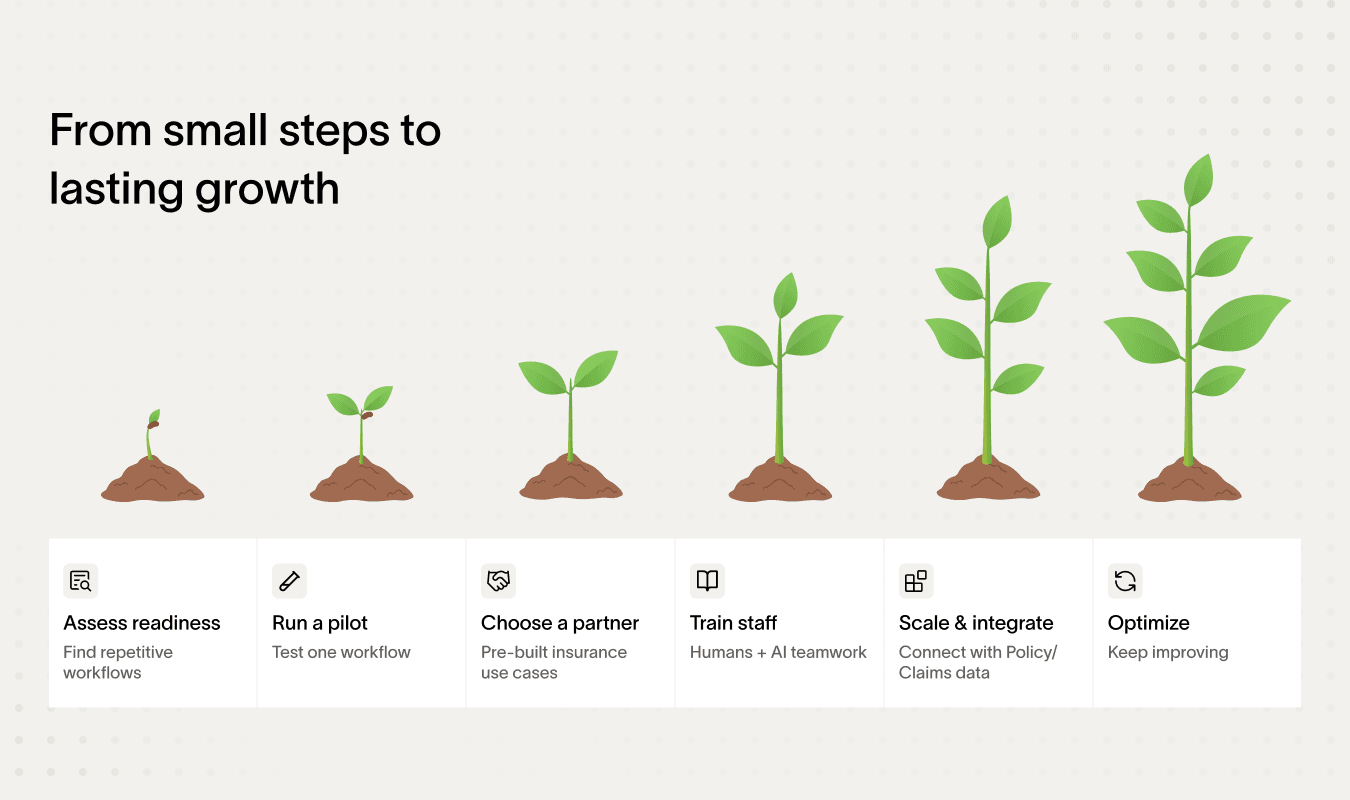
Once you know how to start, it’s worth looking ahead at what conversational AI for insurance could become in the next few years.
What does the future look like?
The next few years will see conversational AI take a central role in insurance.
AI voice agents are becoming the front line for many insurers, handling routine inquiries, capturing customer information, and guiding policyholders through common tasks.
This allows human agents to focus on what they do best: empathy, complex decision-making, and building trust.
Beyond handling calls, AI is also a powerful insight engine. By analyzing call data, insurers can identify trends, spot opportunities, and make better business decisions. AI is all about helping shape strategy.
The future will rely on a hybrid model. AI will manage volume and repetitive tasks, while humans tackle exceptions, high-value conversations, and emotionally sensitive interactions. This combination ensures efficiency without losing the human touch that matters in insurance.
All these ideas point to one thing: conversational AI isn’t a distant possibility. It’s shaping insurance today and will define the future.
Conclusion
Conversational AI isn’t some far-off idea. It’s changing insurance right now. Carriers, MGAs, and brokers are already using it to serve customers faster, keep more policies, and scale without adding endless headcount.
And while chat matters, the phone is still where most of insurance happens. That’s why voice-first AI is the real game-changer. With Strada, routine calls get handled smoothly, details are captured accurately, and human agents are freed up for the moments that truly need empathy and expertise. Customers get answers right away, without losing the personal touch.
The playbook is simple: start small, prove it with a pilot, and grow from there. The companies that lean in today won’t just keep up. They’ll lead the way.
Want to see how? Book a Strada demo and experience voice AI in action.
Frequently asked questions
How can conversational AI improve claims accuracy?
By automating initial assessments and using AI to verify information, claims accuracy increases. Conversational AI for insurance helps reduce human errors by validating data in real-time. This speeds up claim resolutions while maintaining consistency.
What types of insurance policies benefit most from AI conversations?
Life, auto, health, and property insurance policies see great improvements through conversational AI. These products involve frequent customer queries and complex data, making AI-driven interactions highly effective. Conversational AI for insurance customizes recommendations to fit individual needs efficiently.
How does conversational AI handle complex customer questions?
Advanced AI models analyze context and past interactions to tackle complex queries. If needed, the system routes tricky issues to specialized human agents. Using conversational AI for insurance ensures that customers get accurate answers without frustration.
What is the impact of conversational AI on lead generation?
Conversational AI engages visitors, qualifies leads quickly, and schedules follow-ups automatically. This increases conversion rates by providing instant and personalized interactions. Integrating conversational AI for insurance enhances marketing effectiveness.
How quickly can insurers implement conversational AI solutions?
Implementation speed varies based on system complexity and integration needs but typically ranges from weeks to months. Starting with clear goals and prepared data accelerates deployment. Conversational AI for insurance requires continuous tuning post-launch for best results.
Table of Contents
Carriers, MGAs, and brokers scale revenue-driving phone calls with Strada's conversational AI platform.
Start scaling with voice AI agents today
Join innovative carriers and MGAs transforming their calls with Strada.
Conversational AI in Insurance: A Complete 2026 Guide
Amir Prodensky
CEO
10 min read
A practical roadmap to faster service and happier policyholders
Why does insurance need conversational AI?
Let’s be honest: insurance has some frustrating pain points.
Customers sit on hold for too long. Calls get missed. Agents spend hours on manual data entry. The result? Delays, errors, and customers who feel ignored.
Now fast-forward to 2026. People expect instant answers, 24/7. If a policyholder has a question at midnight, they don’t want to wait until business hours. If they call during the day, they don’t want to be stuck in a queue.
They expect smooth, on-demand service, every time. That’s where conversational AI steps in. It solves the pain points that slow insurers down:
- Long hold times → AI handles routine calls instantly.
- Missed calls → AI ensures every call is answered.
- Manual data entry → AI captures and logs details automatically.
- Customer frustration → AI delivers fast, consistent responses.
Some companies are already proving what’s possible. For example, we at Strada position ourselves around “never miss a call again.” Our AI-powered voice agents enable you to answer 100% of calls, day or night.
That means carriers, MGAs, and brokers can stay available without burning out their teams.
When you remove friction from conversations, everyone wins. Customers feel heard and valued. Agents focus on the tough, high-value cases. Businesses save time and money.
With these challenges in mind, here’s how conversational AI is actually being applied across customer service, sales, and internal operations.
How is conversational AI used in insurance?
From customer calls to back-office tasks, conversational AI makes interactions faster, smoother, and more efficient.
Let’s look at where it delivers the most value.
| Area | What AI does | Benefit for insurers |
| Customer service | Provides policy details, verifies coverage, answers questions | Reduces hold times, improves satisfaction |
| Sales & Renewals | Qualifies leads, runs reminders, supports upsells | Higher conversions, more revenue |
| Quote intake | Captures customer info and logs into AMS/CRM | Saves agent time, prevents errors |
| Claims management | Guides customers through claim status, updates, and next steps | Faster resolution, better customer experience |
| FNOL capture | Captures first loss details, validates information, and routes to adjusters | Speeds up claim initiation, reduces costs |
General-purpose AI tools, like ChatGPT or cross-industry tools, need heavy customization.
Strada takes a different approach.
It comes with pre-built insurance-specific use cases: FNOL process automation, policy servicing, renewals, and quote intake. That means insurers can get started faster and see results quickly, without long setup times.
Seeing AI in action is useful, but what really matters is the difference it makes for customers, agents, and business outcomes.
What benefits do the best conversational AI for insurance applications bring?
The biggest reason insurers are adopting conversational AI is simple – it makes service faster, easier, and more reliable for both customers and agents.
To put it simply, conversational AI brings four key benefits:
| Benefit | How it helps | Real-world conversational AI insurance impact |
| #1 Growth | Smart lead follow-ups, renewals, and upsells | An agent misses fewer opportunities – e.g., Strada automatically follows up on a quote, leading to more policies renewed and higher revenue. |
| #2 Reliability | 24/7 coverage with consistent, accurate responses | A customer calling at midnight about a claim gets the right answer instantly |
| #3 Speed | Instant answers with zero hold times | Instead of waiting 10 minutes on hold, a customer gets help immediately, leaving them feeling valued and less frustrated. |
| #4 Efficiency | Scales without extra headcount | Strada can handle thousands of calls in a day (like processing auto accident or storm damage claims during peak season) without hiring more staff. |
For insurers, that’s not just an upgrade. It’s a competitive advantage.
Of course, every powerful tool comes with hurdles. So, let’s look at the main challenges insurers face when adopting conversational AI.
What are the main challenges?
If you’re in insurance, you know the stakes are high. You’re dealing with sensitive data, strict rules, and customers who expect a personal touch.
Here are the challenges that conversational AI can bring to the table:
- Privacy & Security → Policyholders share sensitive financial and personal details. A single data breach can ruin trust and damage your brand.
- Compliance → Insurance is tightly regulated. agentic AI in insurance has to follow the same rules as human agents: disclosures, record-keeping, everything. No shortcuts.
- Integration → Most carriers and brokers still use legacy AMS, PAS, CMS platforms. Connecting AI into these can be messy and, if done wrong, creates data silos or broken workflows.
- Human balance → Customers want speed, but they also expect empathy, especially during claims. AI should handle routine tasks, while humans step in for complex or emotional calls.
Our team at Strada is addressing these head-on. Our platform is SOC 2 Type 2 compliant, undergoes regular penetration testing and offers data isolation and privacy-first LLM usage. That means insurers can adopt AI with confidence, knowing security and compliance are built in.
To understand how these challenges are addressed, it helps to know the technologies behind conversational AI.
What technologies power conversational AI for insurance?
Conversational AI may feel like magic, but it’s really a mix of powerful technologies working together. Each piece plays a role in making conversations feel natural, useful, and fast.
Let’s break down the main ones you’ll see in insurance today.
1. Large Language Models (LLMs) for conversation
LLMs are the brain of voice AI. They take the words customers use and generate clear, natural responses in real time. Instead of sticking to rigid scripts, LLMs understand context, nuance, and phrasing.
This makes conversations feel more like talking to a person than interacting with a machine. In insurance, that means customers get answers that adapt to their situation, no matter if they’re reporting a claim, checking coverage, or asking a simple question.
2. Transcription and Speech Models for voice
Transcription and speech models handle the “voice” part of voice AI:
- Transcription (speech-to-text) turns spoken words into text that the AI can process.
- Speech generation (text-to-speech) turns the AI’s response back into a natural-sounding voice.
Together, they make real-time conversations possible. Customers can talk the way they normally do, and the AI responds instantly in a clear, human-like voice.
Without these models, voice AI would feel robotic and frustrating.
3. Generative AI for dynamic responses
This is where things move beyond simple scripts. Generative AI creates dynamic, context-aware responses instead of canned replies.
That means conversations can feel more natural, flexible, and engaging. In insurance, it also helps the AI adapt when a customer asks something unexpected.
4. Omni-channel integrations
Customers don’t stick to one channel. They might start on chat, switch to a phone call, and later get a follow-up email. Conversational AI needs to move with them.
Omni-channel integration ensures the experience is smooth across chat, phone, SMS, and email. No repeating information.
No dead ends.
And that’s where Strada stands out.
While many tools focus only on chat, Strada goes deep on phone-based AI agents. Calls are still the lifeblood of insurance, and Strada automates them without losing the personal touch. But it doesn’t stop there.
Strada agents can take live actions, like sending an SMS confirmation, emailing a document, transferring to a human agent, or scheduling a call.
Even more, Strada integrates directly with insurance systems like AMS, Policy Admin, and Claims systems. That means data flows automatically, reducing manual entry and ensuring every conversation is tied to your existing workflow.
When you put these technologies together, you get something powerful: an AI that listens, understands, responds naturally, and connects across every channel. For insurers, that means more efficient operations, happier customers, and a future where conversations happen seamlessly, anytime, anywhere.
Still, technology is powerful, but in insurance, it’s constantly evolving. Let’s explore the trends that are driving conversational AI forward in 2026.
What are the latest trends in 2026?
Conversational AI in insurance isn’t standing still. In 2026, several clear trends are shaping how carriers and brokers use this technology.
If you want to stay ahead, here are the key developments to watch.
Voice-first insurance services
Phones remain the main way customers contact insurers, so voice-first AI is taking off fast. Instead of waiting on hold, policyholders can speak directly with AI agents who capture details, answer questions, and escalate when needed.
Strada leads in this space with phone-based AI that handles real conversations and even takes live actions, like sending SMS updates, emailing documents, or scheduling follow-ups. This approach is especially useful for claims and urgent inquiries.
Customers get quick answers, and human agents aren’t tied up with routine calls.
Hyper-personalized renewals and retention campaigns
Renewals have always been a challenge for insurers, but AI makes them smarter. In 2026, AI scoring models help identify which customers are most likely to lapse, letting insurers reach out with tailored campaigns.
Personalization goes beyond simply using a customer’s name. AI can suggest add-ons, highlight coverage updates, or adjust timing to match each policyholder’s habits.
The result is fewer lost policies, stronger loyalty, and higher conversion rates, all without extra work for your team.
AI copilots for agents
Insurance workflow automation isn’t here to replace humans. It’s here to help. AI copilots now support agents during complex calls by surfacing relevant policy information, suggesting next steps, and even taking notes in real time.
This frees agents to focus on empathy, problem-solving, and building trust – things machines can’t do. Customers get faster, more accurate service, and agents feel empowered rather than overwhelmed.
It’s a win-win for everyone.
Seamless integrations with insurance systems
Finally, AI works best when it connects smoothly with existing systems. In 2026, conversational AI should integrate directly with AMS, policy, and claims platforms.
This keeps data flowing, reduces double entry, and cuts errors. Teams can keep their familiar workflows while gaining AI-driven efficiencies.
Smooth integrations make adoption easier, and your AI solution becomes a real partner in everyday operations.
Together, these trends show where insurance is heading: faster service, more personalized engagement, smarter tools for agents, and stronger customer relationships. For insurers, the message is clear: conversational AI for insurance isn’t just a trend. It’s becoming the new standard for how insurance gets done.
Trends are inspiring, but seeing how insurers are actually using AI makes it real.
What are some real-world examples?
Insurance companies are already seeing real benefits from conversational AI.
Take us at Strada, for example. Together with Tint, we created an AI agent, “Aimee,” that works seamlessly alongside human teams.
Fernanda Soares, Senior Manager at Tint, explains, “Leveraging Strada as a foundation, we’ve created Aimee to complement our support team. It allows us to scale with confidence, while keeping trust, governance, and human expertise at the center of every customer experience.”
Aimee handles routine calls, captures customer details accurately, and escalates complex issues to humans when needed. This approach speeds up service without losing the personal touch that customers value.
The impact is clear. Customers enjoy faster responses and fewer errors. Teams can follow up with better-qualified leads. And insurers see higher retention rates thanks to proactive outreach.
By combining AI efficiency with human expertise, companies create a smoother, more satisfying customer experience.
If these examples resonate, the next step is figuring out how your organization can start small and scale successfully.
How can an insurer get started with conversational AI?
Getting started with conversational AI in insurance doesn’t have to be complicated. The key is to take a structured, step-by-step approach: start small, prove value, and scale strategically.
Here’s a practical roadmap for insurers.
| Step | What to do | Tip for success (with example) |
| 1. Assess readiness | Identify high-volume, repetitive workflows that eat up staff time | Start with renewals or quote intake – e.g., let AI collect info before an agent reviews it. |
| 2. Run a pilot | Test a single workflow in a controlled way | Measure call success, accuracy, and satisfaction, for example, track if customers complete a quote without human help. |
| 3. Choose a partner | Pick a solution with pre-built insurance workflows | Saves months of setup = no need to custom-build disclosures or policy questions from scratch. |
| 4. Train staff | Show your team how AI and humans work together | Reinforce that AI handles routine tasks (e.g., scheduling), while agents focus on complex cases. |
| 5. Scale and integrate | Connect AI to policy and claims systems | Automate follow-ups like sending a renewal reminder email right after a call. |
| 6. Optimize continuously | Gather feedback, refine processes, and expand use | If customers say SMS reminders work better than email, adjust quickly and roll out across channels. |
Think of it like planting a tree: start small, nurture it, and soon you have a system that grows and bears fruit across your business.
Once you know how to start, it’s worth looking ahead at what conversational AI for insurance could become in the next few years.
What does the future look like?
The next few years will see conversational AI take a central role in insurance.
AI voice agents are becoming the front line for many insurers, handling routine inquiries, capturing customer information, and guiding policyholders through common tasks.
This allows human agents to focus on what they do best: empathy, complex decision-making, and building trust.
Beyond handling calls, AI is also a powerful insight engine. By analyzing call data, insurers can identify trends, spot opportunities, and make better business decisions. AI is all about helping shape strategy.
The future will rely on a hybrid model. AI will manage volume and repetitive tasks, while humans tackle exceptions, high-value conversations, and emotionally sensitive interactions. This combination ensures efficiency without losing the human touch that matters in insurance.
All these ideas point to one thing: conversational AI isn’t a distant possibility. It’s shaping insurance today and will define the future.
Conclusion
Conversational AI isn’t some far-off idea. It’s changing insurance right now. Carriers, MGAs, and brokers are already using it to serve customers faster, keep more policies, and scale without adding endless headcount.
And while chat matters, the phone is still where most of insurance happens. That’s why voice-first AI is the real game-changer. With Strada, routine calls get handled smoothly, details are captured accurately, and human agents are freed up for the moments that truly need empathy and expertise. Customers get answers right away, without losing the personal touch.
The playbook is simple: start small, prove it with a pilot, and grow from there. The companies that lean in today won’t just keep up. They’ll lead the way.
Want to see how? Book a Strada demo and experience voice AI in action.
Frequently asked questions
How can conversational AI improve claims accuracy?
By automating initial assessments and using AI to verify information, claims accuracy increases. Conversational AI for insurance helps reduce human errors by validating data in real-time. This speeds up claim resolutions while maintaining consistency.
What types of insurance policies benefit most from AI conversations?
Life, auto, health, and property insurance policies see great improvements through conversational AI. These products involve frequent customer queries and complex data, making AI-driven interactions highly effective. Conversational AI for insurance customizes recommendations to fit individual needs efficiently.
How does conversational AI handle complex customer questions?
Advanced AI models analyze context and past interactions to tackle complex queries. If needed, the system routes tricky issues to specialized human agents. Using conversational AI for insurance ensures that customers get accurate answers without frustration.
What is the impact of conversational AI on lead generation?
Conversational AI engages visitors, qualifies leads quickly, and schedules follow-ups automatically. This increases conversion rates by providing instant and personalized interactions. Integrating conversational AI for insurance enhances marketing effectiveness.
How quickly can insurers implement conversational AI solutions?
Implementation speed varies based on system complexity and integration needs but typically ranges from weeks to months. Starting with clear goals and prepared data accelerates deployment. Conversational AI for insurance requires continuous tuning post-launch for best results.
Table of Contents
Carriers, MGAs, and brokers scale revenue-driving phone calls with Strada's conversational AI platform.
Start scaling with voice AI agents today
Join innovative carriers and MGAs transforming their calls with Strada.
Conversational AI in Insurance: A Complete 2026 Guide
Amir Prodensky
CEO
10 min read
A practical roadmap to faster service and happier policyholders
Why does insurance need conversational AI?
Let’s be honest: insurance has some frustrating pain points.
Customers sit on hold for too long. Calls get missed. Agents spend hours on manual data entry. The result? Delays, errors, and customers who feel ignored.
Now fast-forward to 2026. People expect instant answers, 24/7. If a policyholder has a question at midnight, they don’t want to wait until business hours. If they call during the day, they don’t want to be stuck in a queue.
They expect smooth, on-demand service, every time. That’s where conversational AI steps in. It solves the pain points that slow insurers down:
- Long hold times → AI handles routine calls instantly.
- Missed calls → AI ensures every call is answered.
- Manual data entry → AI captures and logs details automatically.
- Customer frustration → AI delivers fast, consistent responses.
Some companies are already proving what’s possible. For example, we at Strada position ourselves around “never miss a call again.” Our AI-powered voice agents enable you to answer 100% of calls, day or night.
That means carriers, MGAs, and brokers can stay available without burning out their teams.
When you remove friction from conversations, everyone wins. Customers feel heard and valued. Agents focus on the tough, high-value cases. Businesses save time and money.
With these challenges in mind, here’s how conversational AI is actually being applied across customer service, sales, and internal operations.
How is conversational AI used in insurance?
From customer calls to back-office tasks, conversational AI makes interactions faster, smoother, and more efficient.
Let’s look at where it delivers the most value.
| Area | What AI does | Benefit for insurers |
| Customer service | Provides policy details, verifies coverage, answers questions | Reduces hold times, improves satisfaction |
| Sales & Renewals | Qualifies leads, runs reminders, supports upsells | Higher conversions, more revenue |
| Quote intake | Captures customer info and logs into AMS/CRM | Saves agent time, prevents errors |
| Claims management | Guides customers through claim status, updates, and next steps | Faster resolution, better customer experience |
| FNOL capture | Captures first loss details, validates information, and routes to adjusters | Speeds up claim initiation, reduces costs |
General-purpose AI tools, like ChatGPT or cross-industry tools, need heavy customization.
Strada takes a different approach.
It comes with pre-built insurance-specific use cases: FNOL process automation, policy servicing, renewals, and quote intake. That means insurers can get started faster and see results quickly, without long setup times.
Seeing AI in action is useful, but what really matters is the difference it makes for customers, agents, and business outcomes.
What benefits do the best conversational AI for insurance applications bring?
The biggest reason insurers are adopting conversational AI is simple – it makes service faster, easier, and more reliable for both customers and agents.
To put it simply, conversational AI brings four key benefits:
| Benefit | How it helps | Real-world conversational AI insurance impact |
| #1 Growth | Smart lead follow-ups, renewals, and upsells | An agent misses fewer opportunities – e.g., Strada automatically follows up on a quote, leading to more policies renewed and higher revenue. |
| #2 Reliability | 24/7 coverage with consistent, accurate responses | A customer calling at midnight about a claim gets the right answer instantly |
| #3 Speed | Instant answers with zero hold times | Instead of waiting 10 minutes on hold, a customer gets help immediately, leaving them feeling valued and less frustrated. |
| #4 Efficiency | Scales without extra headcount | Strada can handle thousands of calls in a day (like processing auto accident or storm damage claims during peak season) without hiring more staff. |
For insurers, that’s not just an upgrade. It’s a competitive advantage.
Of course, every powerful tool comes with hurdles. So, let’s look at the main challenges insurers face when adopting conversational AI.
What are the main challenges?
If you’re in insurance, you know the stakes are high. You’re dealing with sensitive data, strict rules, and customers who expect a personal touch.
Here are the challenges that conversational AI can bring to the table:
- Privacy & Security → Policyholders share sensitive financial and personal details. A single data breach can ruin trust and damage your brand.
- Compliance → Insurance is tightly regulated. agentic AI in insurance has to follow the same rules as human agents: disclosures, record-keeping, everything. No shortcuts.
- Integration → Most carriers and brokers still use legacy AMS, PAS, CMS platforms. Connecting AI into these can be messy and, if done wrong, creates data silos or broken workflows.
- Human balance → Customers want speed, but they also expect empathy, especially during claims. AI should handle routine tasks, while humans step in for complex or emotional calls.
Our team at Strada is addressing these head-on. Our platform is SOC 2 Type 2 compliant, undergoes regular penetration testing and offers data isolation and privacy-first LLM usage. That means insurers can adopt AI with confidence, knowing security and compliance are built in.
To understand how these challenges are addressed, it helps to know the technologies behind conversational AI.
What technologies power conversational AI for insurance?
Conversational AI may feel like magic, but it’s really a mix of powerful technologies working together. Each piece plays a role in making conversations feel natural, useful, and fast.
Let’s break down the main ones you’ll see in insurance today.
1. Large Language Models (LLMs) for conversation
LLMs are the brain of voice AI. They take the words customers use and generate clear, natural responses in real time. Instead of sticking to rigid scripts, LLMs understand context, nuance, and phrasing.
This makes conversations feel more like talking to a person than interacting with a machine. In insurance, that means customers get answers that adapt to their situation, no matter if they’re reporting a claim, checking coverage, or asking a simple question.
2. Transcription and Speech Models for voice
Transcription and speech models handle the “voice” part of voice AI:
- Transcription (speech-to-text) turns spoken words into text that the AI can process.
- Speech generation (text-to-speech) turns the AI’s response back into a natural-sounding voice.
Together, they make real-time conversations possible. Customers can talk the way they normally do, and the AI responds instantly in a clear, human-like voice.
Without these models, voice AI would feel robotic and frustrating.
3. Generative AI for dynamic responses
This is where things move beyond simple scripts. Generative AI creates dynamic, context-aware responses instead of canned replies.
That means conversations can feel more natural, flexible, and engaging. In insurance, it also helps the AI adapt when a customer asks something unexpected.
4. Omni-channel integrations
Customers don’t stick to one channel. They might start on chat, switch to a phone call, and later get a follow-up email. Conversational AI needs to move with them.
Omni-channel integration ensures the experience is smooth across chat, phone, SMS, and email. No repeating information.
No dead ends.
And that’s where Strada stands out.
While many tools focus only on chat, Strada goes deep on phone-based AI agents. Calls are still the lifeblood of insurance, and Strada automates them without losing the personal touch. But it doesn’t stop there.
Strada agents can take live actions, like sending an SMS confirmation, emailing a document, transferring to a human agent, or scheduling a call.
Even more, Strada integrates directly with insurance systems like AMS, Policy Admin, and Claims systems. That means data flows automatically, reducing manual entry and ensuring every conversation is tied to your existing workflow.
When you put these technologies together, you get something powerful: an AI that listens, understands, responds naturally, and connects across every channel. For insurers, that means more efficient operations, happier customers, and a future where conversations happen seamlessly, anytime, anywhere.
Still, technology is powerful, but in insurance, it’s constantly evolving. Let’s explore the trends that are driving conversational AI forward in 2026.
What are the latest trends in 2026?
Conversational AI in insurance isn’t standing still. In 2026, several clear trends are shaping how carriers and brokers use this technology.
If you want to stay ahead, here are the key developments to watch.
Voice-first insurance services
Phones remain the main way customers contact insurers, so voice-first AI is taking off fast. Instead of waiting on hold, policyholders can speak directly with AI agents who capture details, answer questions, and escalate when needed.
Strada leads in this space with phone-based AI that handles real conversations and even takes live actions, like sending SMS updates, emailing documents, or scheduling follow-ups. This approach is especially useful for claims and urgent inquiries.
Customers get quick answers, and human agents aren’t tied up with routine calls.
Hyper-personalized renewals and retention campaigns
Renewals have always been a challenge for insurers, but AI makes them smarter. In 2026, AI scoring models help identify which customers are most likely to lapse, letting insurers reach out with tailored campaigns.
Personalization goes beyond simply using a customer’s name. AI can suggest add-ons, highlight coverage updates, or adjust timing to match each policyholder’s habits.
The result is fewer lost policies, stronger loyalty, and higher conversion rates, all without extra work for your team.
AI copilots for agents
Insurance workflow automation isn’t here to replace humans. It’s here to help. AI copilots now support agents during complex calls by surfacing relevant policy information, suggesting next steps, and even taking notes in real time.
This frees agents to focus on empathy, problem-solving, and building trust – things machines can’t do. Customers get faster, more accurate service, and agents feel empowered rather than overwhelmed.
It’s a win-win for everyone.
Seamless integrations with insurance systems
Finally, AI works best when it connects smoothly with existing systems. In 2026, conversational AI should integrate directly with AMS, policy, and claims platforms.
This keeps data flowing, reduces double entry, and cuts errors. Teams can keep their familiar workflows while gaining AI-driven efficiencies.
Smooth integrations make adoption easier, and your AI solution becomes a real partner in everyday operations.
Together, these trends show where insurance is heading: faster service, more personalized engagement, smarter tools for agents, and stronger customer relationships. For insurers, the message is clear: conversational AI for insurance isn’t just a trend. It’s becoming the new standard for how insurance gets done.
Trends are inspiring, but seeing how insurers are actually using AI makes it real.
What are some real-world examples?
Insurance companies are already seeing real benefits from conversational AI.
Take us at Strada, for example. Together with Tint, we created an AI agent, “Aimee,” that works seamlessly alongside human teams.
Fernanda Soares, Senior Manager at Tint, explains, “Leveraging Strada as a foundation, we’ve created Aimee to complement our support team. It allows us to scale with confidence, while keeping trust, governance, and human expertise at the center of every customer experience.”
Aimee handles routine calls, captures customer details accurately, and escalates complex issues to humans when needed. This approach speeds up service without losing the personal touch that customers value.
The impact is clear. Customers enjoy faster responses and fewer errors. Teams can follow up with better-qualified leads. And insurers see higher retention rates thanks to proactive outreach.
By combining AI efficiency with human expertise, companies create a smoother, more satisfying customer experience.
If these examples resonate, the next step is figuring out how your organization can start small and scale successfully.
How can an insurer get started with conversational AI?
Getting started with conversational AI in insurance doesn’t have to be complicated. The key is to take a structured, step-by-step approach: start small, prove value, and scale strategically.
Here’s a practical roadmap for insurers.
| Step | What to do | Tip for success (with example) |
| 1. Assess readiness | Identify high-volume, repetitive workflows that eat up staff time | Start with renewals or quote intake – e.g., let AI collect info before an agent reviews it. |
| 2. Run a pilot | Test a single workflow in a controlled way | Measure call success, accuracy, and satisfaction, for example, track if customers complete a quote without human help. |
| 3. Choose a partner | Pick a solution with pre-built insurance workflows | Saves months of setup = no need to custom-build disclosures or policy questions from scratch. |
| 4. Train staff | Show your team how AI and humans work together | Reinforce that AI handles routine tasks (e.g., scheduling), while agents focus on complex cases. |
| 5. Scale and integrate | Connect AI to policy and claims systems | Automate follow-ups like sending a renewal reminder email right after a call. |
| 6. Optimize continuously | Gather feedback, refine processes, and expand use | If customers say SMS reminders work better than email, adjust quickly and roll out across channels. |
Think of it like planting a tree: start small, nurture it, and soon you have a system that grows and bears fruit across your business.
Once you know how to start, it’s worth looking ahead at what conversational AI for insurance could become in the next few years.
What does the future look like?
The next few years will see conversational AI take a central role in insurance.
AI voice agents are becoming the front line for many insurers, handling routine inquiries, capturing customer information, and guiding policyholders through common tasks.
This allows human agents to focus on what they do best: empathy, complex decision-making, and building trust.
Beyond handling calls, AI is also a powerful insight engine. By analyzing call data, insurers can identify trends, spot opportunities, and make better business decisions. AI is all about helping shape strategy.
The future will rely on a hybrid model. AI will manage volume and repetitive tasks, while humans tackle exceptions, high-value conversations, and emotionally sensitive interactions. This combination ensures efficiency without losing the human touch that matters in insurance.
All these ideas point to one thing: conversational AI isn’t a distant possibility. It’s shaping insurance today and will define the future.
Conclusion
Conversational AI isn’t some far-off idea. It’s changing insurance right now. Carriers, MGAs, and brokers are already using it to serve customers faster, keep more policies, and scale without adding endless headcount.
And while chat matters, the phone is still where most of insurance happens. That’s why voice-first AI is the real game-changer. With Strada, routine calls get handled smoothly, details are captured accurately, and human agents are freed up for the moments that truly need empathy and expertise. Customers get answers right away, without losing the personal touch.
The playbook is simple: start small, prove it with a pilot, and grow from there. The companies that lean in today won’t just keep up. They’ll lead the way.
Want to see how? Book a Strada demo and experience voice AI in action.
Frequently asked questions
How can conversational AI improve claims accuracy?
By automating initial assessments and using AI to verify information, claims accuracy increases. Conversational AI for insurance helps reduce human errors by validating data in real-time. This speeds up claim resolutions while maintaining consistency.
What types of insurance policies benefit most from AI conversations?
Life, auto, health, and property insurance policies see great improvements through conversational AI. These products involve frequent customer queries and complex data, making AI-driven interactions highly effective. Conversational AI for insurance customizes recommendations to fit individual needs efficiently.
How does conversational AI handle complex customer questions?
Advanced AI models analyze context and past interactions to tackle complex queries. If needed, the system routes tricky issues to specialized human agents. Using conversational AI for insurance ensures that customers get accurate answers without frustration.
What is the impact of conversational AI on lead generation?
Conversational AI engages visitors, qualifies leads quickly, and schedules follow-ups automatically. This increases conversion rates by providing instant and personalized interactions. Integrating conversational AI for insurance enhances marketing effectiveness.
How quickly can insurers implement conversational AI solutions?
Implementation speed varies based on system complexity and integration needs but typically ranges from weeks to months. Starting with clear goals and prepared data accelerates deployment. Conversational AI for insurance requires continuous tuning post-launch for best results.
Table of Contents
Carriers, MGAs, and brokers scale revenue-driving phone calls with Strada's conversational AI platform.
Start scaling with voice AI agents today
Join innovative carriers and MGAs transforming their calls with Strada.

Agentic AI for insurance operations
© 2026 Strada API, Inc.
Agentic AI for insurance operations
© 2026 Strada API, Inc.
Agentic AI for insurance operations
© 2026 Strada API, Inc.