Introducing Strada Signals, our new report series on AI for insurance operations. Read our whitepaper →
Introducing Strada Signals, our new report series on AI for insurance operations.
Read our whitepaper →
Introducing Strada Signals, our new report series on AI for insurance operations. Read our whitepaper →
The Ultimate Guide to FNOL Process Automation [2026 Updated]

Amir Prodensky
CEO
11 min read
Cut costs and speed up FNOL with automation & Voice AI
What does an optimized FNOL automation process flow look like?
Imagine a claims experience that feels easy, fast, and stress-free, for both customers and your team. That’s what an optimized and accurate claims processing delivers.
Instead of long calls, missing data, and back-and-forth emails, every step works smoothly.
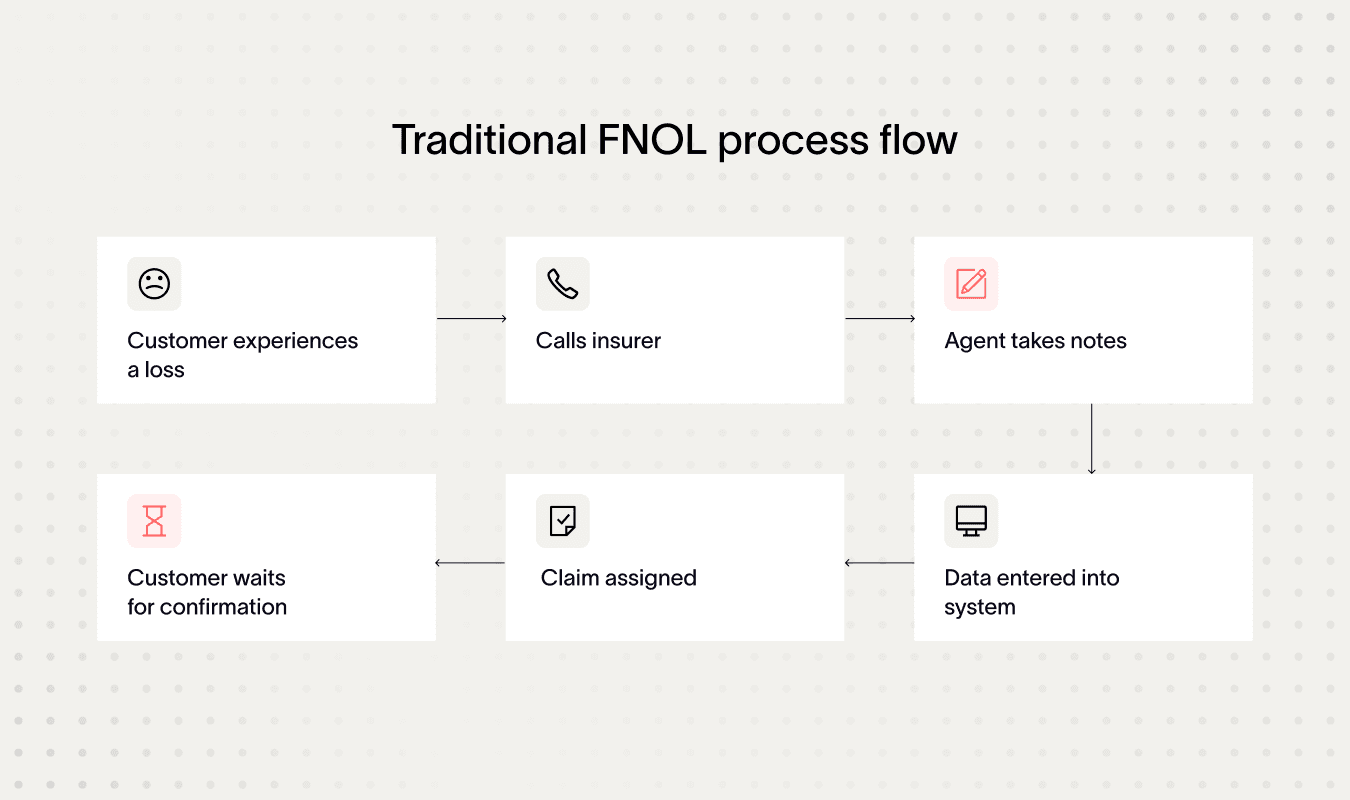
| Step in workflow | Traditional FNOL (claims process) | Optimized digital FNOL with AI |
| Report loss | Long calls, hold times | Instant phone, app, or web intake |
| Intake details | Manual questions, errors | Automated capture + validation |
| Log claim | Manual data entry | Real-time system updates |
| Assign claim | Queued manually | Smart triage + instant routing |
| Customer confirmation | Often missing | Automated SMS/email updates |
Let’s break down the hallmarks of a modern FNOL process.
1. Seamless FNOL intake, both digital and voice
Customers should be able to report a loss in the way that’s easiest for them. That might be through a phone call, a mobile app, or a web form.
The key is making every option simple and consistent. No matter which digital channels they use, the experience should feel quick and straightforward.
2. Automated data capture and validation
Instead of relying on manual note-taking, modern systems capture details automatically. Policy numbers, claim details, and even supporting documents can be validated in real time.
This reduces errors, eliminates duplicate work, and speeds up the process from the very first interaction.
3. Real-time triaging and assignment in claim processes
Once the loss is reported, the claim should move instantly to the right adjuster or team. FNOL automation makes sure nothing sits in a queue, and urgent claims get priority right away.
This cuts down on delays and improves customer confidence.
4. Proactive communication with policyholders aboiut claim status
Customers don’t want to wonder what’s happening with their claim. An optimized process sends updates automatically (through text, email, or phone), so policyholders always know what’s next. This kind of communication builds trust and keeps frustration low.
Now let’s go a step further. An optimized FNOL process doesn’t just handle the basics. It also supports the broader insurance journey.
- Claim status updates provided immediately. When customers call in, they can get real-time visibility into where their claim stands, without needing to wait for an agent to research or call them back.
- Proactive outbound claim updates. Customers automatically receive SMS or call notifications whenever a claim progresses, keeping them informed without having to chase for updates.
- FNOL details accurately captured 24/7. Even during spikes in call volume, like after a major weather event, intake should run smoothly without adding staff.
What ties all of this together? Speed, accuracy, and empathy. Speed means customers get answers quickly. Accuracy ensures details are right the first time. And empathy – the human side of the process – makes customers feel cared for at a stressful moment.
Of course, you can’t optimize FNOL automation in claims by willpower alone. The real shift comes when technology steps in to remove friction and speed things up.
How can technology transform first notice of loss automation?
Technology has already changed how insurers work, but when it comes to FNOL, it’s a real game-changer.
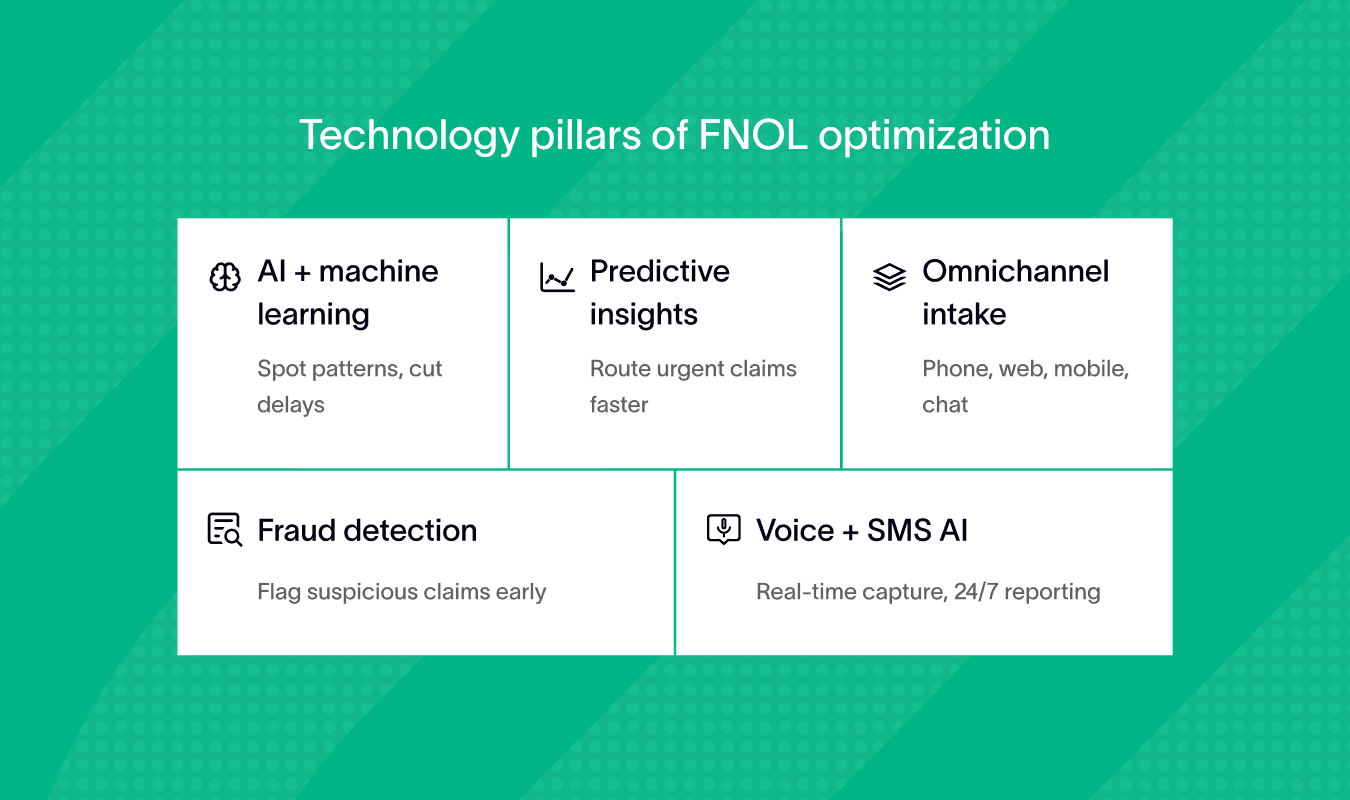
Modern FNOL software makes it possible to collect details faster, reduces errors, and gives customers a smoother experience from the start.
Let’s look at the key ways it’s transforming the process.
AI and machine learning in claims
These tools help spot patterns and process information at scale. Instead of relying only on human review, AI can analyze claim details instantly, cutting hours or even days out of the process.
Predictive insights for faster triage
AI can quickly identify claim severity and route it to the right team. That means urgent cases get immediate attention, while straightforward claims move along without delay.
Automated potential fraud detection
Fraudulent claims cost time and money. Machine learning models can flag suspicious activity early, reducing losses and keeping processes fair for honest customers.
Omnichannel intake (digital FNOL)
Customers don’t want to be tied to one option. With modern platforms, they can report a loss by phone, mobile app, web, or even chat. The experience should feel seamless no matter how they choose to connect.
Voice + SMS + AI agents for real-time reporting
FNOL still happens mostly by phone. That’s why voice and SMS AI is so important. It captures information instantly, ensures accuracy, and makes 24/7 reporting possible without adding staff.
Platforms like Strada bring this to life, giving insurers a way to handle calls faster and customers a way to feel heard right away.
Among all the new FNOL automation software, one stands out. Here are some details.
Why is voice and SMS AI a game-changer for FNOL automation software?
Even with apps, websites, and chat options, most customers still reach for the phone when reporting a loss. Why?
Because in a stressful moment, talking to someone feels easier and more natural than typing into a form. That’s why phone calls continue to dominate FNOL, and why optimizing those calls is critical.
The problem is, traditional phone intake is slow and prone to mistakes. Agents juggle long calls, type notes while listening, and sometimes miss key details. That’s where voice AI changes everything.
With voice AI for call centers, the conversation is captured instantly and accurately. No need for manual note-taking or double-checking policy numbers. The system validates data as it’s collected, reducing errors and cutting down average handle times. What used to take 20 minutes can now take a fraction of that.
Another big advantage is scale. Customers don’t always call during business hours. Spikes happen after storms, accidents, or big events. With voice AI, you can offer 24/7 support without burning out your staff. Calls are answered immediately, details are captured, and customers feel cared for, even at 2 a.m.
And the journey doesn’t stop when the call ends. SMS AI takes over to handle the follow-ups. Customers can text back photos of damage, receive their policy documents on demand, or get real-time claim updates without ever waiting on hold.
The system automatically organizes these exchanges, attaches the right files to the claim, and keeps both the customer and adjuster in sync.
It’s simple, fast, and removes the back-and-forth that usually drags the process out for days.
This is where Strada stands out. It’s not just generic AI. It’s specialized voice and SMS AI built for insurance. That means:
- Purpose-built models trained to understand insurance terminology.
- Proven use cases like FNOL, renewals, quote follow-up, and policy servicing.
- Scalability to handle thousands of inbound or outbound calls without heavy engineering work.
- Accuracy and compliance with built-in evaluation tools that reduce E&O risk.
For insurers, that means fewer bottlenecks, cleaner data, and happier customers. For policyholders, it means fast answers, less waiting, and the reassurance that their claim is in good hands.
But even the best technology won’t deliver results without the right approach. Let’s look at the best practices that make FNOL automation in claims both efficient and human.
What are the best practices for FNOL automation and optimization?
Optimizing digital FNOL isn’t just about adding new tech. It’s about building a process that’s simple, reliable, and human.
Here are some best practices you can put into action right away.
| Best practice | What it looks like in practice | Quick self-check question |
| Easy reporting | Multiple intake channels (phone, app, web) | Can customers report a loss in under 5 minutes? |
| Automated intake | AI captures + sends data to claims system | Does your team retype notes after every call? |
| System integration | CRM, AMS, claims all connected | Do staff still copy-paste between systems? |
| Staff training | Adjusters use AI workflows confidently | Do employees see AI as a helper, not a hurdle? |
| Balanced empathy + efficiency | AI handles routine, humans handle complex | Do customers feel both fast service and care? |
Put these practices together, and you’ll create a claims process flow that’s faster, smarter, and more customer-friendly.
Knowing best practices is one thing, putting them into action is another. Here’s a step-by-step way to get started without feeling overwhelmed.
How can insurers get started with FNOL optimization?
Shifting from a traditional FNOL process flow to a modern, optimized, AI-driven first notice of loss can feel overwhelming. The good news is you don’t have to do everything at once.
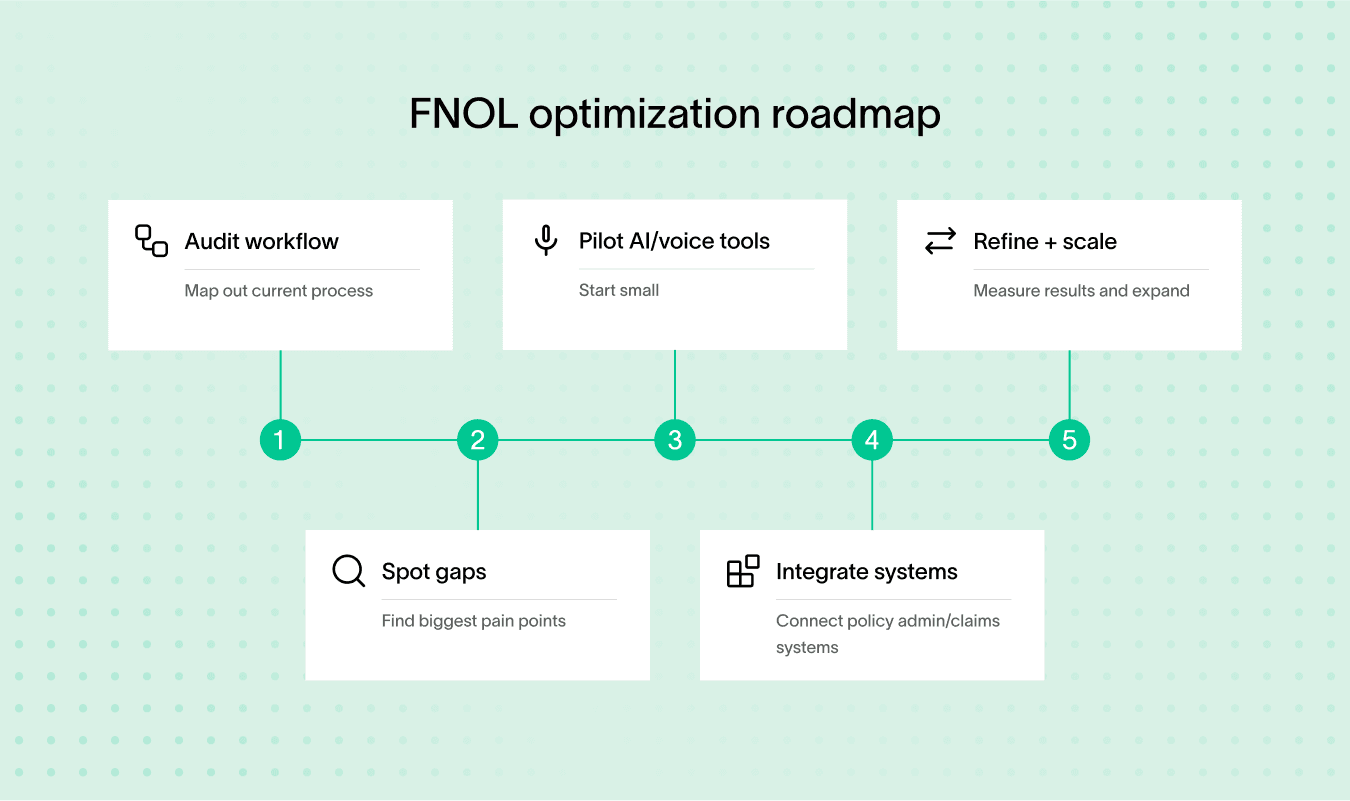
By following a clear set of steps, you can make steady progress, see results quickly, and build momentum for long-term change.
Here’s a roadmap you can follow.
1. Audit your current automated FNOL processing workflow
Start with a clear picture of where you are today.
Map out each step from the moment a customer reports a loss to when the insurance claim gets assigned. Look for bottlenecks like long call times, missing information, or unnecessary delays in communication.
Talk to both staff and policyholders to understand pain points.
2. Identify the biggest gaps and pain points in customer experience
Not every issue needs fixing right away. Focus on the areas that cause the most frustration or cost the most time.
For example, maybe agents spend too much time entering data, or customers complain about being left in the dark after filing. Pick the top two or three issues to prioritize.
3. Pilot artificial intelligence and voice automation solutions
You don’t need a full overhaul to start seeing benefits. Begin with a pilot. Agentic AI platforms like Strada are built for insurance and can handle routine FNOL intake instantly.
By automating common calls, you’ll reduce hold times, capture cleaner data, and free up staff for complex cases.
4. Integrate with claims management systems
Automation works best when it connects to the existing systems. Make sure your new tools feed directly into your claims management or policy admin platforms. That way, information doesn’t get stuck in silos, and adjusters always see a single source of truth.
Strada, for example, supports API and native integrations to keep everything in sync.
5. Track, refine, and scale
Don’t think of optimization with first notice of loss software as a one-time project. Monitor key metrics like call handling time, claim setup accuracy, and customer satisfaction. Use the data to refine FNOL workflows, adjust training, and add new use cases. Once the pilot proves its value, expand to more lines of business or customer interactions.
And this is where Strada comes into play. It’s a voice AI platform built for insurance that makes these steps not just possible, but practical.
Where does Strada fit in?
By now, it’s clear that FNOL automation and optimization depends on speed, accuracy, and empathy. But knowing what’s possible and actually making it happen are two different things.
That’s where Strada comes in.
Strada is a purpose-built voice AI platform designed specifically for insurance. Unlike generic call bots or broad AI tools, Strada focuses on the unique challenges of carriers, MGAs, and brokers. It handles phone calls (the front office lifeline of insurance) with intelligence and empathy.
Think of it as phone AI for the insurance front office. Instead of putting customers on hold or asking your staff to handle every routine call, Strada’s AI agents step in. They answer instantly, capture details accurately, and pass information into your systems in real time.
That frees up your human adjusters and service reps to focus on complex cases where empathy and judgment matter most.
Here’s how Strada helps insurers optimize FNOL and beyond:
- Scales revenue-driving calls. No matter if it’s sales, renewals, or policy servicing, Strada helps insurers handle thousands of inbound and outbound conversations without adding headcount.
- Delivers real results. It’s more cost effective than staffing alone, answers over 85% of calls, and offers true 24/7 availability. Customers never have to wait for help, even in peak times.
- Builds trust through accuracy. Strada comes with built-in evaluation tools that ensure conversations are accurate and compliant. This reduces errors and minimizes E&O risk.
- Keeps data secure. Enterprise-grade security is part of the foundation. Strada is SOC 2 Type 2 certified, isolates customer data, and ensures training data privacy. That means your information and your customers’ stays protected.
The best part is that Strada doesn’t require heavy engineering to get started. It integrates smoothly with CRMs, policy administration, and claims management systems. That means you can start small, see quick wins, and scale quickly without a massive IT project.
For insurers, the impact is clear: fewer bottlenecks, lower costs, and happier customers. For policyholders, it means faster FNOL reporting, instant status updates, and the comfort of knowing their insurer is available any time, day or night.
Strada isn’t about replacing people. It’s about handling the repetitive, routine calls that slow everyone down. By taking on that work, Strada lets your team do what they do best: delivering empathy, solving complex problems, and building long-term relationships.
Of course, you can’t improve what you don’t measure. Once you’ve started using FNOL automation, you’ll need the right metrics to track success.
How do you measure automated FNOL performance in your claims system?
You can’t improve what you don’t measure. Tracking the right metrics helps you spot problems, prove ROI, and show customers you’re serious about service.
Here are the key metrics to keep an eye on:
| Metric | Why it matters | Traditional process result | With Strada and FNOL automation |
| First call resolution | Solves claim setup on first call | Low–medium | High (most claims setup first call) |
| Average handling time | Faster calls mean lower costs | 20–30 minutes | 5–10 minutes |
| Claim setup accuracy | Prevents rework and delays | Error-prone, manual | High accuracy, validated data |
| Customer satisfaction (CSAT) | Shows trust and loyalty | Mixed, often low | Higher, thanks to faster service |
| Calls answered instantly | No wait = better experience | 50–60% in peak times | 100% answered instantly |
| Availability | Customers want 24/7 access | Limited to business hours | 24/7/365 support |
Metrics are just the start.
The real value comes from using analytics to drive continuous improvement. By looking at patterns over time, you’ll know where to focus training, where call center automation helps most, and which changes deliver the biggest impact.
This is where platforms like Strada make a difference. You don’t just get a FNOL automation. You get measurable improvements:
- 100% of calls answered instantly so no more long waits.
- Multilingual support so every customer feels understood.
- 24/7/365 availability so customers never feel stranded.
When you combine these proof points with your own tracking, you’ll see exactly how FNOL optimization pays off. Faster calls, fewer errors, and happier customers. That’s how you measure success.
All these pieces come together into one clear picture: FNOL optimization isn’t optional anymore. It’s the foundation for faster claims, happier customers, and leaner operations.
Is your FNOL automation process ready for 2026?
FNOL has always been the “moment of truth” in insurance, and in 2026, it matters more than ever. Customers expect speed, accuracy, and empathy from the very first call. If you get FNOL right, you set the stage for an entire claims journey.
If you don’t, you risk losing trust before the process even begins.
The payoff for optimizing FNOL is clear:
- Faster claims that move without bottlenecks
- Happier customers who feel supported at every step
- Leaner operations that save time and cut costs
The tools to make this possible are already here. Voice AI, FNOL process automation, and real-time analytics are transforming how insurers handle intake and service.
And platforms like Strada make it practical to adopt these innovations quickly. With purpose-built voice AI agents for insurance, you can answer more calls, capture cleaner data, and deliver support 24/7, without adding more strain on your team.
FNOL optimization isn’t a future project. It’s the key to staying competitive now. Start small, scale fast, and use next-gen tools like Strada to future-proof your automated FNOL processing and your customer relationships.
Frequently asked questions
How does FNOL automation improve claim accuracy?
Automation reduces human errors by using AI to validate and cross-check claim details instantly. This improves data reliability and supports better decision-making. Conversational FNOL helps gather precise information directly from claimants, increasing input accuracy.
What role do chatbots play in FNOL automation?
Chatbots manage initial claim conversations quickly and clearly, guiding claimants through the process step-by-step. They collect consistent data, reduce wait times, and keep communication open. Conversational FNOL relies heavily on these AI-driven chatbots to provide immediate responses.
Can FNOL automation handle emergency cases?
Yes, automated systems can detect urgent claims and instantly alert emergency services or field teams when necessary. This quick response saves lives and minimizes further damage. Integration of telematics often supports such real-time urgency detection.
What is the role of Robotic Process Automation (RPA) in FNOL?
RPA handles repetitive administrative tasks like data entry and document routing automatically. It frees human agents for more complex cases and shortens processing times. RPA complements conversational FNOL by efficiently managing backend workflows.
How is fraud detection improved in FNOL automation?
AI-driven tools analyze patterns and flag inconsistencies far quicker than manual review. Machine learning models adapt over time to detect new fraud tactics. Combining these capabilities with conversational FNOL helps verify claimant credibility early.
Table of Contents
Carriers, MGAs, and brokers scale revenue-driving phone calls with Strada's conversational AI platform.
Start scaling with voice AI agents today
Join innovative carriers and MGAs transforming their calls with Strada.
The Ultimate Guide to FNOL Process Automation [2026 Updated]

Amir Prodensky
CEO
11 min read
Cut costs and speed up FNOL with automation & Voice AI
What does an optimized FNOL automation process flow look like?
Imagine a claims experience that feels easy, fast, and stress-free, for both customers and your team. That’s what an optimized and accurate claims processing delivers.
Instead of long calls, missing data, and back-and-forth emails, every step works smoothly.
| Step in workflow | Traditional FNOL (claims process) | Optimized digital FNOL with AI |
| Report loss | Long calls, hold times | Instant phone, app, or web intake |
| Intake details | Manual questions, errors | Automated capture + validation |
| Log claim | Manual data entry | Real-time system updates |
| Assign claim | Queued manually | Smart triage + instant routing |
| Customer confirmation | Often missing | Automated SMS/email updates |
Let’s break down the hallmarks of a modern FNOL process.
1. Seamless FNOL intake, both digital and voice
Customers should be able to report a loss in the way that’s easiest for them. That might be through a phone call, a mobile app, or a web form.
The key is making every option simple and consistent. No matter which digital channels they use, the experience should feel quick and straightforward.
2. Automated data capture and validation
Instead of relying on manual note-taking, modern systems capture details automatically. Policy numbers, claim details, and even supporting documents can be validated in real time.
This reduces errors, eliminates duplicate work, and speeds up the process from the very first interaction.
3. Real-time triaging and assignment in claim processes
Once the loss is reported, the claim should move instantly to the right adjuster or team. FNOL automation makes sure nothing sits in a queue, and urgent claims get priority right away.
This cuts down on delays and improves customer confidence.
4. Proactive communication with policyholders aboiut claim status
Customers don’t want to wonder what’s happening with their claim. An optimized process sends updates automatically (through text, email, or phone), so policyholders always know what’s next. This kind of communication builds trust and keeps frustration low.
Now let’s go a step further. An optimized FNOL process doesn’t just handle the basics. It also supports the broader insurance journey.
- Claim status updates provided immediately. When customers call in, they can get real-time visibility into where their claim stands, without needing to wait for an agent to research or call them back.
- Proactive outbound claim updates. Customers automatically receive SMS or call notifications whenever a claim progresses, keeping them informed without having to chase for updates.
- FNOL details accurately captured 24/7. Even during spikes in call volume, like after a major weather event, intake should run smoothly without adding staff.
What ties all of this together? Speed, accuracy, and empathy. Speed means customers get answers quickly. Accuracy ensures details are right the first time. And empathy – the human side of the process – makes customers feel cared for at a stressful moment.
Of course, you can’t optimize FNOL automation in claims by willpower alone. The real shift comes when technology steps in to remove friction and speed things up.
How can technology transform first notice of loss automation?
Technology has already changed how insurers work, but when it comes to FNOL, it’s a real game-changer.
Modern FNOL software makes it possible to collect details faster, reduces errors, and gives customers a smoother experience from the start.
Let’s look at the key ways it’s transforming the process.
AI and machine learning in claims
These tools help spot patterns and process information at scale. Instead of relying only on human review, AI can analyze claim details instantly, cutting hours or even days out of the process.
Predictive insights for faster triage
AI can quickly identify claim severity and route it to the right team. That means urgent cases get immediate attention, while straightforward claims move along without delay.
Automated potential fraud detection
Fraudulent claims cost time and money. Machine learning models can flag suspicious activity early, reducing losses and keeping processes fair for honest customers.
Omnichannel intake (digital FNOL)
Customers don’t want to be tied to one option. With modern platforms, they can report a loss by phone, mobile app, web, or even chat. The experience should feel seamless no matter how they choose to connect.
Voice + SMS + AI agents for real-time reporting
FNOL still happens mostly by phone. That’s why voice and SMS AI is so important. It captures information instantly, ensures accuracy, and makes 24/7 reporting possible without adding staff.
Platforms like Strada bring this to life, giving insurers a way to handle calls faster and customers a way to feel heard right away.
Among all the new FNOL automation software, one stands out. Here are some details.
Why is voice and SMS AI a game-changer for FNOL automation software?
Even with apps, websites, and chat options, most customers still reach for the phone when reporting a loss. Why?
Because in a stressful moment, talking to someone feels easier and more natural than typing into a form. That’s why phone calls continue to dominate FNOL, and why optimizing those calls is critical.
The problem is, traditional phone intake is slow and prone to mistakes. Agents juggle long calls, type notes while listening, and sometimes miss key details. That’s where voice AI changes everything.
With voice AI for call centers, the conversation is captured instantly and accurately. No need for manual note-taking or double-checking policy numbers. The system validates data as it’s collected, reducing errors and cutting down average handle times. What used to take 20 minutes can now take a fraction of that.
Another big advantage is scale. Customers don’t always call during business hours. Spikes happen after storms, accidents, or big events. With voice AI, you can offer 24/7 support without burning out your staff. Calls are answered immediately, details are captured, and customers feel cared for, even at 2 a.m.
And the journey doesn’t stop when the call ends. SMS AI takes over to handle the follow-ups. Customers can text back photos of damage, receive their policy documents on demand, or get real-time claim updates without ever waiting on hold.
The system automatically organizes these exchanges, attaches the right files to the claim, and keeps both the customer and adjuster in sync.
It’s simple, fast, and removes the back-and-forth that usually drags the process out for days.
This is where Strada stands out. It’s not just generic AI. It’s specialized voice and SMS AI built for insurance. That means:
- Purpose-built models trained to understand insurance terminology.
- Proven use cases like FNOL, renewals, quote follow-up, and policy servicing.
- Scalability to handle thousands of inbound or outbound calls without heavy engineering work.
- Accuracy and compliance with built-in evaluation tools that reduce E&O risk.
For insurers, that means fewer bottlenecks, cleaner data, and happier customers. For policyholders, it means fast answers, less waiting, and the reassurance that their claim is in good hands.
But even the best technology won’t deliver results without the right approach. Let’s look at the best practices that make FNOL automation in claims both efficient and human.
What are the best practices for FNOL automation and optimization?
Optimizing digital FNOL isn’t just about adding new tech. It’s about building a process that’s simple, reliable, and human.
Here are some best practices you can put into action right away.
| Best practice | What it looks like in practice | Quick self-check question |
| Easy reporting | Multiple intake channels (phone, app, web) | Can customers report a loss in under 5 minutes? |
| Automated intake | AI captures + sends data to claims system | Does your team retype notes after every call? |
| System integration | CRM, AMS, claims all connected | Do staff still copy-paste between systems? |
| Staff training | Adjusters use AI workflows confidently | Do employees see AI as a helper, not a hurdle? |
| Balanced empathy + efficiency | AI handles routine, humans handle complex | Do customers feel both fast service and care? |
Put these practices together, and you’ll create a claims process flow that’s faster, smarter, and more customer-friendly.
Knowing best practices is one thing, putting them into action is another. Here’s a step-by-step way to get started without feeling overwhelmed.
How can insurers get started with FNOL optimization?
Shifting from a traditional FNOL process flow to a modern, optimized, AI-driven first notice of loss can feel overwhelming. The good news is you don’t have to do everything at once.
By following a clear set of steps, you can make steady progress, see results quickly, and build momentum for long-term change.
Here’s a roadmap you can follow.
1. Audit your current automated FNOL processing workflow
Start with a clear picture of where you are today.
Map out each step from the moment a customer reports a loss to when the insurance claim gets assigned. Look for bottlenecks like long call times, missing information, or unnecessary delays in communication.
Talk to both staff and policyholders to understand pain points.
2. Identify the biggest gaps and pain points in customer experience
Not every issue needs fixing right away. Focus on the areas that cause the most frustration or cost the most time.
For example, maybe agents spend too much time entering data, or customers complain about being left in the dark after filing. Pick the top two or three issues to prioritize.
3. Pilot artificial intelligence and voice automation solutions
You don’t need a full overhaul to start seeing benefits. Begin with a pilot. Agentic AI platforms like Strada are built for insurance and can handle routine FNOL intake instantly.
By automating common calls, you’ll reduce hold times, capture cleaner data, and free up staff for complex cases.
4. Integrate with claims management systems
Automation works best when it connects to the existing systems. Make sure your new tools feed directly into your claims management or policy admin platforms. That way, information doesn’t get stuck in silos, and adjusters always see a single source of truth.
Strada, for example, supports API and native integrations to keep everything in sync.
5. Track, refine, and scale
Don’t think of optimization with first notice of loss software as a one-time project. Monitor key metrics like call handling time, claim setup accuracy, and customer satisfaction. Use the data to refine FNOL workflows, adjust training, and add new use cases. Once the pilot proves its value, expand to more lines of business or customer interactions.
And this is where Strada comes into play. It’s a voice AI platform built for insurance that makes these steps not just possible, but practical.
Where does Strada fit in?
By now, it’s clear that FNOL automation and optimization depends on speed, accuracy, and empathy. But knowing what’s possible and actually making it happen are two different things.
That’s where Strada comes in.
Strada is a purpose-built voice AI platform designed specifically for insurance. Unlike generic call bots or broad AI tools, Strada focuses on the unique challenges of carriers, MGAs, and brokers. It handles phone calls (the front office lifeline of insurance) with intelligence and empathy.
Think of it as phone AI for the insurance front office. Instead of putting customers on hold or asking your staff to handle every routine call, Strada’s AI agents step in. They answer instantly, capture details accurately, and pass information into your systems in real time.
That frees up your human adjusters and service reps to focus on complex cases where empathy and judgment matter most.
Here’s how Strada helps insurers optimize FNOL and beyond:
- Scales revenue-driving calls. No matter if it’s sales, renewals, or policy servicing, Strada helps insurers handle thousands of inbound and outbound conversations without adding headcount.
- Delivers real results. It’s more cost effective than staffing alone, answers over 85% of calls, and offers true 24/7 availability. Customers never have to wait for help, even in peak times.
- Builds trust through accuracy. Strada comes with built-in evaluation tools that ensure conversations are accurate and compliant. This reduces errors and minimizes E&O risk.
- Keeps data secure. Enterprise-grade security is part of the foundation. Strada is SOC 2 Type 2 certified, isolates customer data, and ensures training data privacy. That means your information and your customers’ stays protected.
The best part is that Strada doesn’t require heavy engineering to get started. It integrates smoothly with CRMs, policy administration, and claims management systems. That means you can start small, see quick wins, and scale quickly without a massive IT project.
For insurers, the impact is clear: fewer bottlenecks, lower costs, and happier customers. For policyholders, it means faster FNOL reporting, instant status updates, and the comfort of knowing their insurer is available any time, day or night.
Strada isn’t about replacing people. It’s about handling the repetitive, routine calls that slow everyone down. By taking on that work, Strada lets your team do what they do best: delivering empathy, solving complex problems, and building long-term relationships.
Of course, you can’t improve what you don’t measure. Once you’ve started using FNOL automation, you’ll need the right metrics to track success.
How do you measure automated FNOL performance in your claims system?
You can’t improve what you don’t measure. Tracking the right metrics helps you spot problems, prove ROI, and show customers you’re serious about service.
Here are the key metrics to keep an eye on:
| Metric | Why it matters | Traditional process result | With Strada and FNOL automation |
| First call resolution | Solves claim setup on first call | Low–medium | High (most claims setup first call) |
| Average handling time | Faster calls mean lower costs | 20–30 minutes | 5–10 minutes |
| Claim setup accuracy | Prevents rework and delays | Error-prone, manual | High accuracy, validated data |
| Customer satisfaction (CSAT) | Shows trust and loyalty | Mixed, often low | Higher, thanks to faster service |
| Calls answered instantly | No wait = better experience | 50–60% in peak times | 100% answered instantly |
| Availability | Customers want 24/7 access | Limited to business hours | 24/7/365 support |
Metrics are just the start.
The real value comes from using analytics to drive continuous improvement. By looking at patterns over time, you’ll know where to focus training, where call center automation helps most, and which changes deliver the biggest impact.
This is where platforms like Strada make a difference. You don’t just get a FNOL automation. You get measurable improvements:
- 100% of calls answered instantly so no more long waits.
- Multilingual support so every customer feels understood.
- 24/7/365 availability so customers never feel stranded.
When you combine these proof points with your own tracking, you’ll see exactly how FNOL optimization pays off. Faster calls, fewer errors, and happier customers. That’s how you measure success.
All these pieces come together into one clear picture: FNOL optimization isn’t optional anymore. It’s the foundation for faster claims, happier customers, and leaner operations.
Is your FNOL automation process ready for 2026?
FNOL has always been the “moment of truth” in insurance, and in 2026, it matters more than ever. Customers expect speed, accuracy, and empathy from the very first call. If you get FNOL right, you set the stage for an entire claims journey.
If you don’t, you risk losing trust before the process even begins.
The payoff for optimizing FNOL is clear:
- Faster claims that move without bottlenecks
- Happier customers who feel supported at every step
- Leaner operations that save time and cut costs
The tools to make this possible are already here. Voice AI, FNOL process automation, and real-time analytics are transforming how insurers handle intake and service.
And platforms like Strada make it practical to adopt these innovations quickly. With purpose-built voice AI agents for insurance, you can answer more calls, capture cleaner data, and deliver support 24/7, without adding more strain on your team.
FNOL optimization isn’t a future project. It’s the key to staying competitive now. Start small, scale fast, and use next-gen tools like Strada to future-proof your automated FNOL processing and your customer relationships.
Frequently asked questions
How does FNOL automation improve claim accuracy?
Automation reduces human errors by using AI to validate and cross-check claim details instantly. This improves data reliability and supports better decision-making. Conversational FNOL helps gather precise information directly from claimants, increasing input accuracy.
What role do chatbots play in FNOL automation?
Chatbots manage initial claim conversations quickly and clearly, guiding claimants through the process step-by-step. They collect consistent data, reduce wait times, and keep communication open. Conversational FNOL relies heavily on these AI-driven chatbots to provide immediate responses.
Can FNOL automation handle emergency cases?
Yes, automated systems can detect urgent claims and instantly alert emergency services or field teams when necessary. This quick response saves lives and minimizes further damage. Integration of telematics often supports such real-time urgency detection.
What is the role of Robotic Process Automation (RPA) in FNOL?
RPA handles repetitive administrative tasks like data entry and document routing automatically. It frees human agents for more complex cases and shortens processing times. RPA complements conversational FNOL by efficiently managing backend workflows.
How is fraud detection improved in FNOL automation?
AI-driven tools analyze patterns and flag inconsistencies far quicker than manual review. Machine learning models adapt over time to detect new fraud tactics. Combining these capabilities with conversational FNOL helps verify claimant credibility early.
Table of Contents
Carriers, MGAs, and brokers scale revenue-driving phone calls with Strada's conversational AI platform.
Start scaling with voice AI agents today
Join innovative carriers and MGAs transforming their calls with Strada.
The Ultimate Guide to FNOL Process Automation [2026 Updated]

Amir Prodensky
CEO
11 min read
Cut costs and speed up FNOL with automation & Voice AI
What does an optimized FNOL automation process flow look like?
Imagine a claims experience that feels easy, fast, and stress-free, for both customers and your team. That’s what an optimized and accurate claims processing delivers.
Instead of long calls, missing data, and back-and-forth emails, every step works smoothly.
| Step in workflow | Traditional FNOL (claims process) | Optimized digital FNOL with AI |
| Report loss | Long calls, hold times | Instant phone, app, or web intake |
| Intake details | Manual questions, errors | Automated capture + validation |
| Log claim | Manual data entry | Real-time system updates |
| Assign claim | Queued manually | Smart triage + instant routing |
| Customer confirmation | Often missing | Automated SMS/email updates |
Let’s break down the hallmarks of a modern FNOL process.
1. Seamless FNOL intake, both digital and voice
Customers should be able to report a loss in the way that’s easiest for them. That might be through a phone call, a mobile app, or a web form.
The key is making every option simple and consistent. No matter which digital channels they use, the experience should feel quick and straightforward.
2. Automated data capture and validation
Instead of relying on manual note-taking, modern systems capture details automatically. Policy numbers, claim details, and even supporting documents can be validated in real time.
This reduces errors, eliminates duplicate work, and speeds up the process from the very first interaction.
3. Real-time triaging and assignment in claim processes
Once the loss is reported, the claim should move instantly to the right adjuster or team. FNOL automation makes sure nothing sits in a queue, and urgent claims get priority right away.
This cuts down on delays and improves customer confidence.
4. Proactive communication with policyholders aboiut claim status
Customers don’t want to wonder what’s happening with their claim. An optimized process sends updates automatically (through text, email, or phone), so policyholders always know what’s next. This kind of communication builds trust and keeps frustration low.
Now let’s go a step further. An optimized FNOL process doesn’t just handle the basics. It also supports the broader insurance journey.
- Claim status updates provided immediately. When customers call in, they can get real-time visibility into where their claim stands, without needing to wait for an agent to research or call them back.
- Proactive outbound claim updates. Customers automatically receive SMS or call notifications whenever a claim progresses, keeping them informed without having to chase for updates.
- FNOL details accurately captured 24/7. Even during spikes in call volume, like after a major weather event, intake should run smoothly without adding staff.
What ties all of this together? Speed, accuracy, and empathy. Speed means customers get answers quickly. Accuracy ensures details are right the first time. And empathy – the human side of the process – makes customers feel cared for at a stressful moment.
Of course, you can’t optimize FNOL automation in claims by willpower alone. The real shift comes when technology steps in to remove friction and speed things up.
How can technology transform first notice of loss automation?
Technology has already changed how insurers work, but when it comes to FNOL, it’s a real game-changer.
Modern FNOL software makes it possible to collect details faster, reduces errors, and gives customers a smoother experience from the start.
Let’s look at the key ways it’s transforming the process.
AI and machine learning in claims
These tools help spot patterns and process information at scale. Instead of relying only on human review, AI can analyze claim details instantly, cutting hours or even days out of the process.
Predictive insights for faster triage
AI can quickly identify claim severity and route it to the right team. That means urgent cases get immediate attention, while straightforward claims move along without delay.
Automated potential fraud detection
Fraudulent claims cost time and money. Machine learning models can flag suspicious activity early, reducing losses and keeping processes fair for honest customers.
Omnichannel intake (digital FNOL)
Customers don’t want to be tied to one option. With modern platforms, they can report a loss by phone, mobile app, web, or even chat. The experience should feel seamless no matter how they choose to connect.
Voice + SMS + AI agents for real-time reporting
FNOL still happens mostly by phone. That’s why voice and SMS AI is so important. It captures information instantly, ensures accuracy, and makes 24/7 reporting possible without adding staff.
Platforms like Strada bring this to life, giving insurers a way to handle calls faster and customers a way to feel heard right away.
Among all the new FNOL automation software, one stands out. Here are some details.
Why is voice and SMS AI a game-changer for FNOL automation software?
Even with apps, websites, and chat options, most customers still reach for the phone when reporting a loss. Why?
Because in a stressful moment, talking to someone feels easier and more natural than typing into a form. That’s why phone calls continue to dominate FNOL, and why optimizing those calls is critical.
The problem is, traditional phone intake is slow and prone to mistakes. Agents juggle long calls, type notes while listening, and sometimes miss key details. That’s where voice AI changes everything.
With voice AI for call centers, the conversation is captured instantly and accurately. No need for manual note-taking or double-checking policy numbers. The system validates data as it’s collected, reducing errors and cutting down average handle times. What used to take 20 minutes can now take a fraction of that.
Another big advantage is scale. Customers don’t always call during business hours. Spikes happen after storms, accidents, or big events. With voice AI, you can offer 24/7 support without burning out your staff. Calls are answered immediately, details are captured, and customers feel cared for, even at 2 a.m.
And the journey doesn’t stop when the call ends. SMS AI takes over to handle the follow-ups. Customers can text back photos of damage, receive their policy documents on demand, or get real-time claim updates without ever waiting on hold.
The system automatically organizes these exchanges, attaches the right files to the claim, and keeps both the customer and adjuster in sync.
It’s simple, fast, and removes the back-and-forth that usually drags the process out for days.
This is where Strada stands out. It’s not just generic AI. It’s specialized voice and SMS AI built for insurance. That means:
- Purpose-built models trained to understand insurance terminology.
- Proven use cases like FNOL, renewals, quote follow-up, and policy servicing.
- Scalability to handle thousands of inbound or outbound calls without heavy engineering work.
- Accuracy and compliance with built-in evaluation tools that reduce E&O risk.
For insurers, that means fewer bottlenecks, cleaner data, and happier customers. For policyholders, it means fast answers, less waiting, and the reassurance that their claim is in good hands.
But even the best technology won’t deliver results without the right approach. Let’s look at the best practices that make FNOL automation in claims both efficient and human.
What are the best practices for FNOL automation and optimization?
Optimizing digital FNOL isn’t just about adding new tech. It’s about building a process that’s simple, reliable, and human.
Here are some best practices you can put into action right away.
| Best practice | What it looks like in practice | Quick self-check question |
| Easy reporting | Multiple intake channels (phone, app, web) | Can customers report a loss in under 5 minutes? |
| Automated intake | AI captures + sends data to claims system | Does your team retype notes after every call? |
| System integration | CRM, AMS, claims all connected | Do staff still copy-paste between systems? |
| Staff training | Adjusters use AI workflows confidently | Do employees see AI as a helper, not a hurdle? |
| Balanced empathy + efficiency | AI handles routine, humans handle complex | Do customers feel both fast service and care? |
Put these practices together, and you’ll create a claims process flow that’s faster, smarter, and more customer-friendly.
Knowing best practices is one thing, putting them into action is another. Here’s a step-by-step way to get started without feeling overwhelmed.
How can insurers get started with FNOL optimization?
Shifting from a traditional FNOL process flow to a modern, optimized, AI-driven first notice of loss can feel overwhelming. The good news is you don’t have to do everything at once.
By following a clear set of steps, you can make steady progress, see results quickly, and build momentum for long-term change.
Here’s a roadmap you can follow.
1. Audit your current automated FNOL processing workflow
Start with a clear picture of where you are today.
Map out each step from the moment a customer reports a loss to when the insurance claim gets assigned. Look for bottlenecks like long call times, missing information, or unnecessary delays in communication.
Talk to both staff and policyholders to understand pain points.
2. Identify the biggest gaps and pain points in customer experience
Not every issue needs fixing right away. Focus on the areas that cause the most frustration or cost the most time.
For example, maybe agents spend too much time entering data, or customers complain about being left in the dark after filing. Pick the top two or three issues to prioritize.
3. Pilot artificial intelligence and voice automation solutions
You don’t need a full overhaul to start seeing benefits. Begin with a pilot. Agentic AI platforms like Strada are built for insurance and can handle routine FNOL intake instantly.
By automating common calls, you’ll reduce hold times, capture cleaner data, and free up staff for complex cases.
4. Integrate with claims management systems
Automation works best when it connects to the existing systems. Make sure your new tools feed directly into your claims management or policy admin platforms. That way, information doesn’t get stuck in silos, and adjusters always see a single source of truth.
Strada, for example, supports API and native integrations to keep everything in sync.
5. Track, refine, and scale
Don’t think of optimization with first notice of loss software as a one-time project. Monitor key metrics like call handling time, claim setup accuracy, and customer satisfaction. Use the data to refine FNOL workflows, adjust training, and add new use cases. Once the pilot proves its value, expand to more lines of business or customer interactions.
And this is where Strada comes into play. It’s a voice AI platform built for insurance that makes these steps not just possible, but practical.
Where does Strada fit in?
By now, it’s clear that FNOL automation and optimization depends on speed, accuracy, and empathy. But knowing what’s possible and actually making it happen are two different things.
That’s where Strada comes in.
Strada is a purpose-built voice AI platform designed specifically for insurance. Unlike generic call bots or broad AI tools, Strada focuses on the unique challenges of carriers, MGAs, and brokers. It handles phone calls (the front office lifeline of insurance) with intelligence and empathy.
Think of it as phone AI for the insurance front office. Instead of putting customers on hold or asking your staff to handle every routine call, Strada’s AI agents step in. They answer instantly, capture details accurately, and pass information into your systems in real time.
That frees up your human adjusters and service reps to focus on complex cases where empathy and judgment matter most.
Here’s how Strada helps insurers optimize FNOL and beyond:
- Scales revenue-driving calls. No matter if it’s sales, renewals, or policy servicing, Strada helps insurers handle thousands of inbound and outbound conversations without adding headcount.
- Delivers real results. It’s more cost effective than staffing alone, answers over 85% of calls, and offers true 24/7 availability. Customers never have to wait for help, even in peak times.
- Builds trust through accuracy. Strada comes with built-in evaluation tools that ensure conversations are accurate and compliant. This reduces errors and minimizes E&O risk.
- Keeps data secure. Enterprise-grade security is part of the foundation. Strada is SOC 2 Type 2 certified, isolates customer data, and ensures training data privacy. That means your information and your customers’ stays protected.
The best part is that Strada doesn’t require heavy engineering to get started. It integrates smoothly with CRMs, policy administration, and claims management systems. That means you can start small, see quick wins, and scale quickly without a massive IT project.
For insurers, the impact is clear: fewer bottlenecks, lower costs, and happier customers. For policyholders, it means faster FNOL reporting, instant status updates, and the comfort of knowing their insurer is available any time, day or night.
Strada isn’t about replacing people. It’s about handling the repetitive, routine calls that slow everyone down. By taking on that work, Strada lets your team do what they do best: delivering empathy, solving complex problems, and building long-term relationships.
Of course, you can’t improve what you don’t measure. Once you’ve started using FNOL automation, you’ll need the right metrics to track success.
How do you measure automated FNOL performance in your claims system?
You can’t improve what you don’t measure. Tracking the right metrics helps you spot problems, prove ROI, and show customers you’re serious about service.
Here are the key metrics to keep an eye on:
| Metric | Why it matters | Traditional process result | With Strada and FNOL automation |
| First call resolution | Solves claim setup on first call | Low–medium | High (most claims setup first call) |
| Average handling time | Faster calls mean lower costs | 20–30 minutes | 5–10 minutes |
| Claim setup accuracy | Prevents rework and delays | Error-prone, manual | High accuracy, validated data |
| Customer satisfaction (CSAT) | Shows trust and loyalty | Mixed, often low | Higher, thanks to faster service |
| Calls answered instantly | No wait = better experience | 50–60% in peak times | 100% answered instantly |
| Availability | Customers want 24/7 access | Limited to business hours | 24/7/365 support |
Metrics are just the start.
The real value comes from using analytics to drive continuous improvement. By looking at patterns over time, you’ll know where to focus training, where call center automation helps most, and which changes deliver the biggest impact.
This is where platforms like Strada make a difference. You don’t just get a FNOL automation. You get measurable improvements:
- 100% of calls answered instantly so no more long waits.
- Multilingual support so every customer feels understood.
- 24/7/365 availability so customers never feel stranded.
When you combine these proof points with your own tracking, you’ll see exactly how FNOL optimization pays off. Faster calls, fewer errors, and happier customers. That’s how you measure success.
All these pieces come together into one clear picture: FNOL optimization isn’t optional anymore. It’s the foundation for faster claims, happier customers, and leaner operations.
Is your FNOL automation process ready for 2026?
FNOL has always been the “moment of truth” in insurance, and in 2026, it matters more than ever. Customers expect speed, accuracy, and empathy from the very first call. If you get FNOL right, you set the stage for an entire claims journey.
If you don’t, you risk losing trust before the process even begins.
The payoff for optimizing FNOL is clear:
- Faster claims that move without bottlenecks
- Happier customers who feel supported at every step
- Leaner operations that save time and cut costs
The tools to make this possible are already here. Voice AI, FNOL process automation, and real-time analytics are transforming how insurers handle intake and service.
And platforms like Strada make it practical to adopt these innovations quickly. With purpose-built voice AI agents for insurance, you can answer more calls, capture cleaner data, and deliver support 24/7, without adding more strain on your team.
FNOL optimization isn’t a future project. It’s the key to staying competitive now. Start small, scale fast, and use next-gen tools like Strada to future-proof your automated FNOL processing and your customer relationships.
Frequently asked questions
How does FNOL automation improve claim accuracy?
Automation reduces human errors by using AI to validate and cross-check claim details instantly. This improves data reliability and supports better decision-making. Conversational FNOL helps gather precise information directly from claimants, increasing input accuracy.
What role do chatbots play in FNOL automation?
Chatbots manage initial claim conversations quickly and clearly, guiding claimants through the process step-by-step. They collect consistent data, reduce wait times, and keep communication open. Conversational FNOL relies heavily on these AI-driven chatbots to provide immediate responses.
Can FNOL automation handle emergency cases?
Yes, automated systems can detect urgent claims and instantly alert emergency services or field teams when necessary. This quick response saves lives and minimizes further damage. Integration of telematics often supports such real-time urgency detection.
What is the role of Robotic Process Automation (RPA) in FNOL?
RPA handles repetitive administrative tasks like data entry and document routing automatically. It frees human agents for more complex cases and shortens processing times. RPA complements conversational FNOL by efficiently managing backend workflows.
How is fraud detection improved in FNOL automation?
AI-driven tools analyze patterns and flag inconsistencies far quicker than manual review. Machine learning models adapt over time to detect new fraud tactics. Combining these capabilities with conversational FNOL helps verify claimant credibility early.
Table of Contents
Carriers, MGAs, and brokers scale revenue-driving phone calls with Strada's conversational AI platform.
Start scaling with voice AI agents today
Join innovative carriers and MGAs transforming their calls with Strada.
© 2026 Strada API, Inc.