Introducing Strada Signals, our new report series on AI for insurance operations. Read our whitepaper →
Introducing Strada Signals, our new report series on AI for insurance operations.
Read our whitepaper →
Introducing Strada Signals, our new report series on AI for insurance operations. Read our whitepaper →
The Guide for 2026: From ChatGPT in Insurance to Purpose-Built AI Platforms

Amir Prodensky
CEO
15 min read
Practical steps to bring ChatGPT and Strada into insurance
How are insurers using AI today? (OpenAI & ChatGPT insurance use cases)
Insurance is full of conversations…that’s where OpenAI’s APIs (the technology behind ChatGPT) are already proving useful. Instead of using the consumer app, insurers are embedding these APIs into claims systems, chat portals, and agent dashboards.
That’s where AI is already proving useful.
| Area | ChatGPT & OpenAI APIs help with… | Voice AI platforms (e.g., Strada) handle… |
| Customer support | → Power online FAQs and chatbots. → Draft agent-ready responses for web or app chats. → Provide instant, text-based answers. | → Answer 24/7 phone calls with no hold times. → Route calls to the right agent if needed. → Handle common service requests live. |
| Claims | → Summarize claim notes from adjusters or chats. → Generate follow-up emails or letters. → Extract structured data from transcripts. | → Guide customers through FNOL live on the phone. → Collect and confirm claim details instantly. → Reassure policyholders during stressful events. |
| Policy servicing | → Draft responses for agents to send via chat or email. → Suggest policy explanations in plain language. → Auto-generate reminders or updates. | → Process endorsements, renewals, and billing over the phone. → Take payments securely. → Send confirmations by SMS or email. |
| Agent assistance | → Draft emails, proposals, and renewal notices. → Explain policy details in everyday language. → Summarize long documents quickly. | → Free producers from repetitive inbound/outbound calls. → Screen calls so agents only focus on high-value conversations. |
| Sales | → Support with product FAQs and digital pre-sales material. → Generate lead-nurturing emails. | → Qualify inbound leads by phone. → Handle renewals and upsell opportunities in real time. → Close routine sales without agent involvement. |
While ChatGPT technology is already delivering value in digital channels, insurers are discovering that customer conversations still happen mostly on the phone.
That’s where Strada comes in.
Strada is built specifically for insurance, so it goes deeper than general-purpose AI. It doesn’t just chat on a website; it handles live phone calls end-to-end.
Here’s how insurers use it:
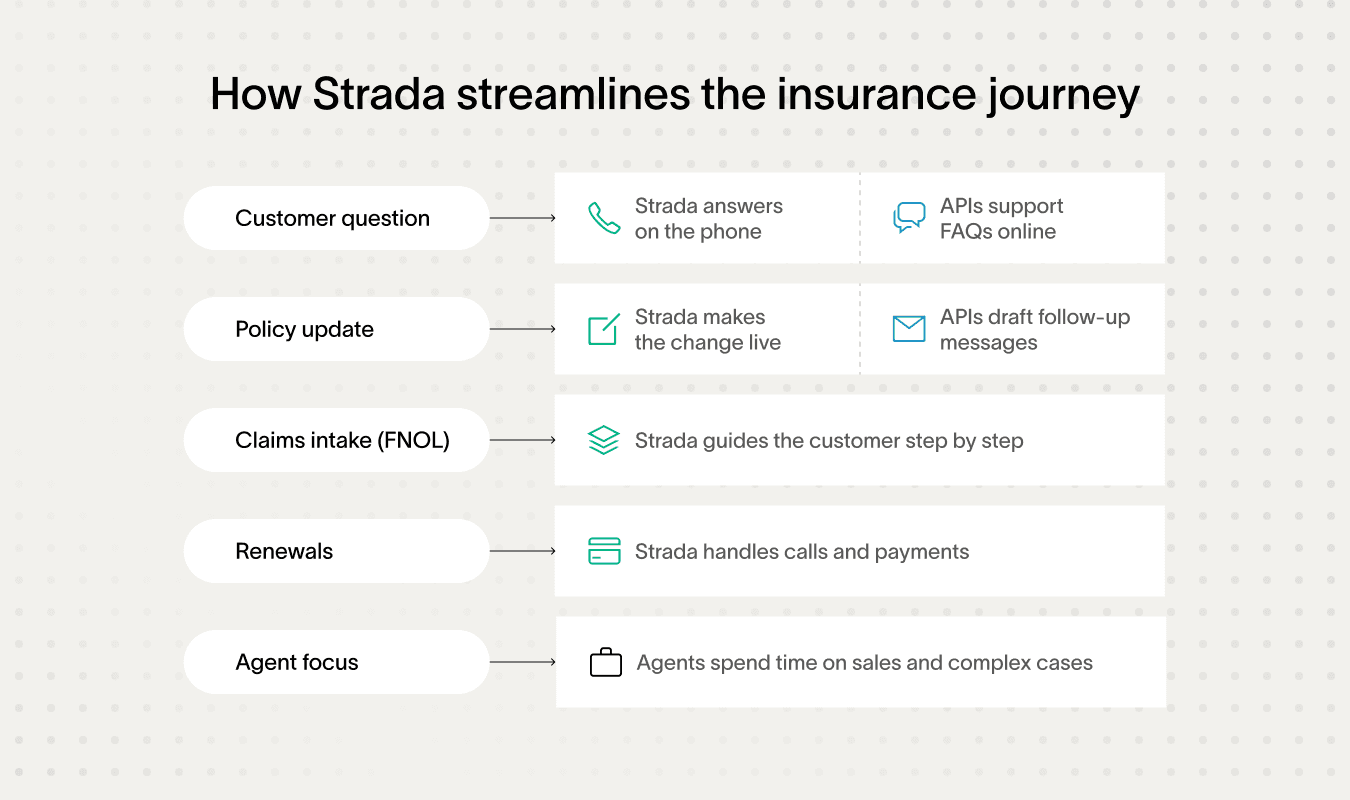
The best part?
Strada frees up producers and service reps from repetitive call handling. Instead of spending hours on basic servicing calls, your team can focus on sales, retention, and complex cases that need a human touch.
That’s why insurers looking for real impact are adding Strada alongside ChatGPT and APIs, because it’s designed for the unique demands of insurance and the phone-first world your customers still rely on.
Of course, every new tool comes with risks. Before you dive in, it’s worth asking: what challenges should leaders keep in mind?
What about the risks and challenges of using ChatGPT for insurance?
Every new technology brings risks, and AI is no different. For insurers, it’s important to understand where the pitfalls are.
With ChatGPT and OpenAI APIs, the challenges are real:
- Incorrect answers. Sometimes it generates confident but wrong responses, which can create confusion or errors in customer interactions.
- Compliance gaps. ChatGPT isn’t built specifically for insurance, so it may not always meet strict regulatory requirements.
- Data privacy. Questions remain about how information is stored, shared, or reused, especially when customer data is sensitive.
That doesn’t mean you can’t use it. It just means you need to manage these risks carefully.
This is where Strada takes a different approach. It’s built with what we call insurance-grade security and governance. That means protecting your data and reducing risk is baked in from day one.
Here’s how Strada addresses these concerns:
- Insurance-trained. Tuned for insurance terminology and tested for accuracy.
- SOC 2 Type 2 compliance. Verified controls to safeguard data.
- Data isolation. Each client’s data is kept completely separate.
- Training data is never reused. Your data never trains anyone else’s model.
- LLM provider privacy. Partnered only with providers that meet strict privacy standards.
- Regular penetration testing. Security is tested constantly to stay ahead of threats.
The result: Strada reduces errors and protects sensitive information while still giving you the speed and efficiency of AI. You don’t have to choose between innovation and compliance.
You can have both.
For insurers, that peace of mind matters. You know your customers’ data is safe, your operations stay compliant, and your team can focus on what they do best – serving clients.
Knowing the risks is one thing. Acting on AI is another.
So, how do insurers actually get started without overwhelming their teams?
How can insurers get started?
The best way to adopt AI in insurance is to take it step by step. You don’t need to overhaul everything at once.
Here’s a simple path for implementing AI, like ChatGPT and OpenAI APIs, for insurance:
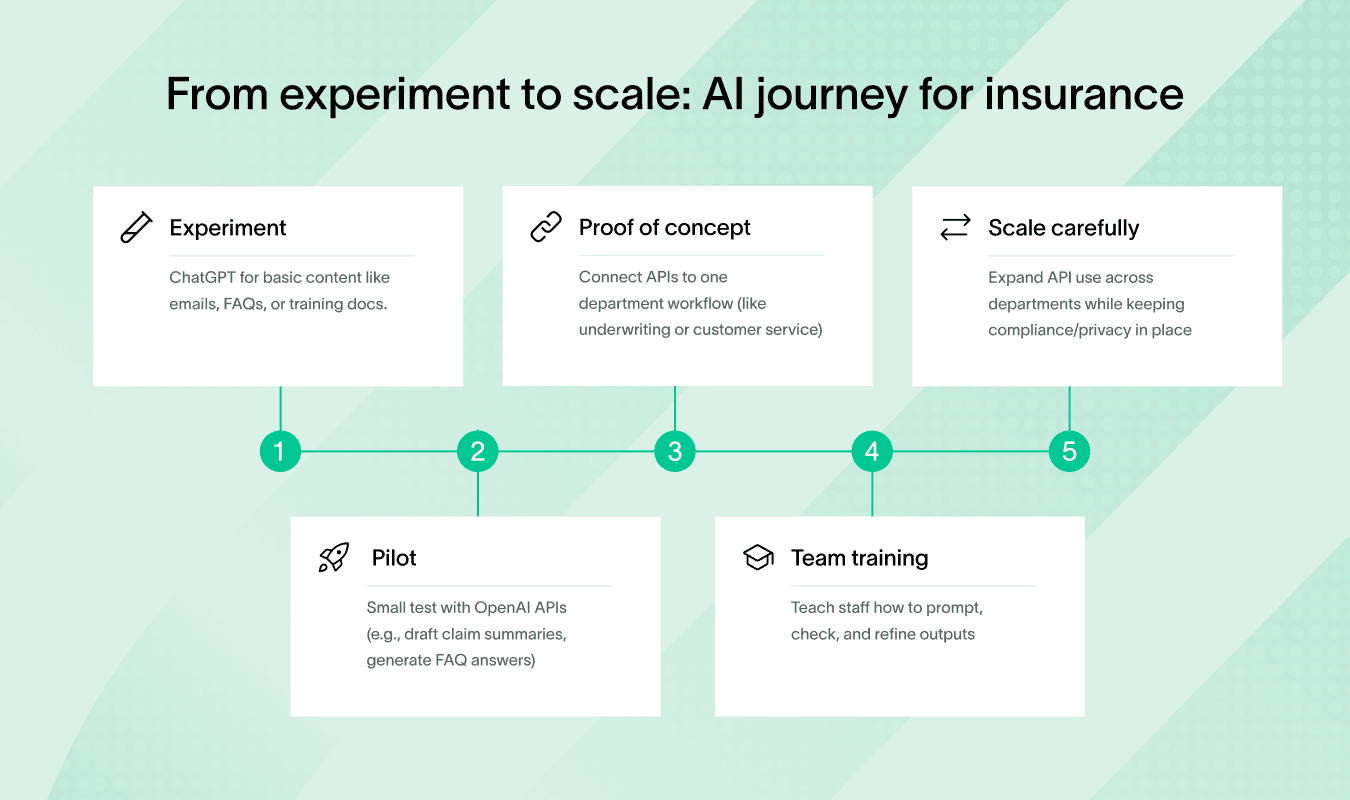
Step 1: Run a small pilot
Pick one low-risk area, like answering FAQs on your website or drafting claim summaries with OpenAI APIs. Limit the scope so you can measure results quickly without major risk.
Step 2: Build a proof of concept
Choose a department (like underwriting or customer service) and run a short project.
For example, let a Claims team use AI to turn messy FNOL transcripts into structured claim details. Track efficiency gains and note any compliance concerns.
Step 3: Train your team
Show staff how to use ChatGPT in the insurance industry effectively. Simple training on how to ask better prompts and double-check responses goes a long way. Also, train them on how to use API-powered features inside your internal tools, so AI feels like a natural part of their daily workflow.
The more comfortable your team feels, the more value you’ll see.
Step 4: Scale carefully
Once you know what works, expand. Add ChatGPT technology to customer service, underwriters, and marketers. Keep compliance and data privacy checks in place as you grow.
Let’s look at what kind of timeline you can expect when starting with each option:
| Step | OpenAI APIs (ChatGPT tech) | Strada typical timeline |
| Pilot launch | 2–4 weeks (set up small API pilot, basic training) | 1–2 weeks (pre-built demo ready to test) |
| Proof of concept | 1–3 months (connect APIs to one system, e.g. claims or service) | 3–4 weeks (deploy first insurance workflow) |
| Team training | Ongoing: staff learn prompts, review outputs, refine workflows | Minimal (flows come ready-to-use) |
| First business impact | 3–6 months (efficiency gains in back-office + digital channels) | Almost immediate (renewals, FNOL, phone calls) |
| Scaling organization | 6–12 months (roll APIs into more teams and processes) | 1–2 months (expand to multiple call types at once) |
Strada, on the other hand, is built for insurance, so the steps look a little different. You don’t need months of engineering or custom builds. It’s designed to launch fast.
Step 1: See it in action
Request a demo. You’ll hear Strada AI agents handle live phone calls for renewals, claims, or service requests.
This gives you a clear picture of what’s possible.
Step 2: Pick a use case
Decide where you want an immediate impact. Common first choices are:
- FNOL (guide customers through claims reporting)
- Policy servicing (answer service requests around the clock)
- Renewals (remind customers of upcoming changes)
- Quote intake (collect details and pass them directly to your claims system)
Step 3: Deploy quickly
Because Strada comes with pre-built insurance workflows, you don’t need an engineering lift.
Launch in weeks, not months.
Step 4: Learn from peers
Follow examples from teams like Tint, which deployed an AI phone agent named Aimee. Aimee now handles service calls, supports producers, and frees agents to focus on sales and retention.
"Leveraging Strada as a foundation, we’ve created Aimee, our AI agent, to seamlessly complement our support team.
It allows us to scale with confidence, while ensuring that trust, governance, and human expertise remain central to every customer experience," said Fernanda Soares, Senior Manager, Business Operations and Strategy at Tint
Step 5: Scale with confidence
Once one workflow works, add more. Strada is infinitely scalable, so you can handle thousands of calls at once without adding staff.
Tip: With Strada, you start fast and see results almost immediately.
Here’s a simple way to think about it:
- Use ChatGPT pilots to explore and train your team on AI.
- Use OpenAI APIs to embed AI directly into your systems and workflows as you scale.
- Use Strada deployments to deliver immediate business impact with customers.
Both approaches move you forward. The key is to start.
AI in insurance isn’t a future trend. It’s here today. By taking these steps now, you’ll give your customers faster service, your agents more time, and your business a stronger edge.
That’s the inside view. But what about the outside? Let’s flip perspectives and see what all this means for your customers.
What does it mean for customers?
At the end of the day, technology only matters if it makes life better for the customer. That’s where AI really shows its impact.
With AI in insurance, customers notice the difference right away:
- Faster service. Simple questions get answered instantly, no waiting for an agent.
- Clearer explanations. Policies and coverage details are translated into plain language, so customers actually understand what they’re buying.
- Personalization. AI remembers context and tailors responses, making interactions feel more relevant and human.
That’s already a big step forward. But phone conversations are still the heart of insurance, and that’s where Strada changes the game.
With Strada, customers get:
Instant answers
With Strada, customers never have to wait on hold again.
Instead of listening to hold music or waiting for office hours, every call is answered instantly, day or night, 24/7.
For example, when a policyholder calls at 10 p.m. after a car accident, Strada is there to respond right away.
Better connections
Strada also makes sure calls actually connect. If a customer misses the first attempt, intelligent insurance workflow automation retries and a trusted caller ID increase the chances they’ll pick up.
Think of it like this: when your client sees a familiar, verified number instead of “Unknown Caller,” they’re far more likely to answer.
Complete service
And once the call is connected, the service doesn’t stop there. Strada can handle the entire interaction: transferring the caller to the right person, sending text message or email confirmations, or even scheduling follow-up appointments.
So if a customer calls to add a driver to their policy, they can hang up knowing the request is complete and an updated certificate is already in their inbox, no need to call back later.
The experience is smooth, immediate, and personal. Strada feels like talking to a knowledgeable insurance rep who always picks up, no matter the time of day.
For customers, that means less frustration and more confidence. For insurers, it means happier policyholders, stronger retention, and fewer missed opportunities.
When you combine the speed of ChatGPT with the phone-first design of Strada, you don’t just modernize operations. You create the kind of customer experience people actually want: fast, clear, and always available.
Customers are already feeling the difference today. But what happens next? The future of AI in insurance is taking shape right now.
What does the future look like for AI in the insurance industry?
AI in insurance isn’t slowing down – it’s accelerating. The next few years will bring even bigger changes to how work gets done.
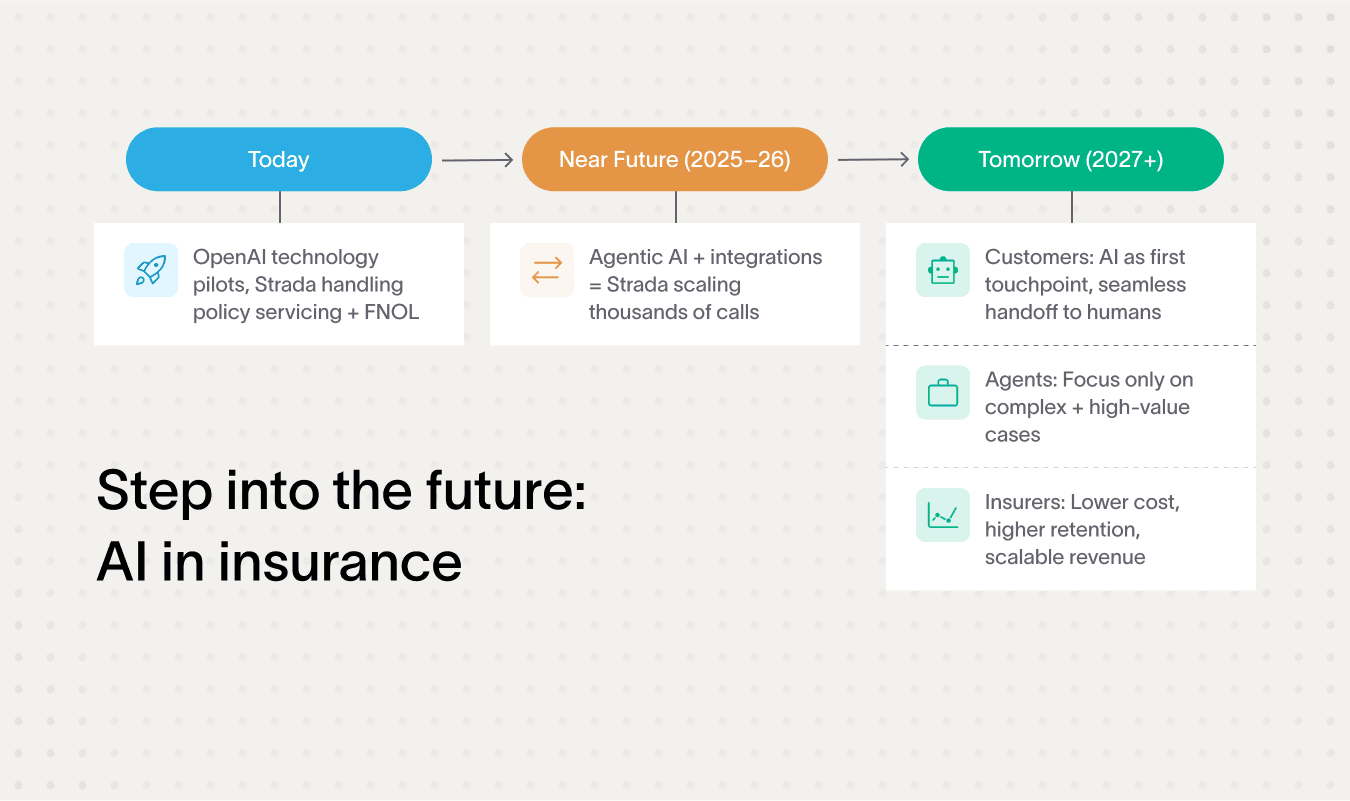
Here’s what’s coming with Strada in insurance: it will handle more of the routine conversations end-to-end, so agents can focus on the complex, high-value moments. Strada will connect directly with AMS, policy admin, and claims systems, making workflows faster and smoother.
Instead of just answering questions, Strada will take action: pulling data, updating records, processing payments, and sending follow-ups automatically. Customers will be able to move seamlessly between AI and human support, depending on their needs.
And as Strada keeps improving in accuracy and compliance, more insurers will rely on it as a core part of their business: scaling service, reducing costs, and delivering a consistently better experience.
That’s the big picture for general-purpose AI. But for phone-first insurance, the future looks even more practical. With Strada, the vision is clear:
- Phone AI becomes normal. Customers won’t think twice about talking to an AI agent for renewals, FNOL, or servicing.
- Agents move up the value chain. Instead of intake and repetitive servicing, human agents focus on closing deals and giving complex advice.
- Revenue scales. Insurers who adopt Strada grow revenue-driving conversations at a fraction of today’s cost, without adding headcount.
To bring it all together, here’s what the insurance world looks like as AI keeps evolving:
The bottom line?
The future isn’t AI replacing people. It’s AI taking on the repetitive work, so people can focus on what they do best: building trust, closing sales, and guiding customers through life’s big moments.
We’ve covered a lot, from ChatGPT and API’s strengths to Strada’s insurance-first design. Let’s wrap it up with the big takeaways and next steps.
Conclusion
ChatGPT is powerful. It’s flexible, popular, and a great way to explore how AI can change insurance. With OpenAI APIs, you can do even more.
But at the end of the day, these are still general-purpose tools.
Strada is different. It’s built for insurance from the ground up. That means:
- Renewals, service, and sales calls handled at scale.
- Insurance-grade security and compliance baked in.
- Phone-first design so customers never wait on hold.
If you’re serious about bringing AI into your insurance business, you don’t have to imagine what’s possible. You can see it live.
Book a demo with Strada and experience how it feels to have a knowledgeable insurance rep who always answers, 24/7.
That’s the future of insurance conversations, and it’s ready today.
Frequently asked questions
What are OpenAI APIs and how do they support insurance applications?
OpenAI APIs provide flexible access to powerful AI models for text generation, understanding, and processing. In insurance, these APIs automate document analysis and customer interactions, enhancing service speed and accuracy without heavy manual work.
How can OpenAI APIs improve claims processing in insurance?
By using OpenAI APIs, insurers can extract key information from unstructured claims documents quickly. This helps reduce processing time and errors, allowing staff to focus on complex decisions rather than routine data handling tasks.
What role do OpenAI APIs play in underwriting risk assessment?
OpenAI APIs analyze large amounts of textual data, including customer inputs and external sources, to identify risk factors. This supports underwriters by providing deeper insights and streamlining risk evaluations based on diverse data points.
How does integration with OpenAI APIs benefit existing insurance platforms?
OpenAI APIs can be seamlessly integrated with CRM and policy management systems, enhancing those tools with natural language processing capabilities. This integration enables smarter automation and more personalized customer interactions.
Are OpenAI APIs customizable for industry-specific needs like insurance terminology?
Developers can fine-tune OpenAI models using insurance-specific data to better understand jargon and regulatory language. This customization improves the accuracy and relevance of AI responses in the insurance domain.
Table of Contents
Carriers, MGAs, and brokers scale revenue-driving phone calls with Strada's conversational AI platform.
Start scaling with voice AI agents today
Join innovative carriers and MGAs transforming their calls with Strada.
The Guide for 2026: From ChatGPT in Insurance to Purpose-Built AI Platforms
Amir Prodensky
CEO
15 min read
Practical steps to bring ChatGPT and Strada into insurance
How are insurers using AI today? (OpenAI & ChatGPT insurance use cases)
Insurance is full of conversations…that’s where OpenAI’s APIs (the technology behind ChatGPT) are already proving useful. Instead of using the consumer app, insurers are embedding these APIs into claims systems, chat portals, and agent dashboards.
That’s where AI is already proving useful.
| Area | ChatGPT & OpenAI APIs help with… | Voice AI platforms (e.g., Strada) handle… |
| Customer support | → Power online FAQs and chatbots. → Draft agent-ready responses for web or app chats. → Provide instant, text-based answers. | → Answer 24/7 phone calls with no hold times. → Route calls to the right agent if needed. → Handle common service requests live. |
| Claims | → Summarize claim notes from adjusters or chats. → Generate follow-up emails or letters. → Extract structured data from transcripts. | → Guide customers through FNOL live on the phone. → Collect and confirm claim details instantly. → Reassure policyholders during stressful events. |
| Policy servicing | → Draft responses for agents to send via chat or email. → Suggest policy explanations in plain language. → Auto-generate reminders or updates. | → Process endorsements, renewals, and billing over the phone. → Take payments securely. → Send confirmations by SMS or email. |
| Agent assistance | → Draft emails, proposals, and renewal notices. → Explain policy details in everyday language. → Summarize long documents quickly. | → Free producers from repetitive inbound/outbound calls. → Screen calls so agents only focus on high-value conversations. |
| Sales | → Support with product FAQs and digital pre-sales material. → Generate lead-nurturing emails. | → Qualify inbound leads by phone. → Handle renewals and upsell opportunities in real time. → Close routine sales without agent involvement. |
While ChatGPT technology is already delivering value in digital channels, insurers are discovering that customer conversations still happen mostly on the phone.
That’s where Strada comes in.
Strada is built specifically for insurance, so it goes deeper than general-purpose AI. It doesn’t just chat on a website; it handles live phone calls end-to-end.
Here’s how insurers use it:
The best part?
Strada frees up producers and service reps from repetitive call handling. Instead of spending hours on basic servicing calls, your team can focus on sales, retention, and complex cases that need a human touch.
That’s why insurers looking for real impact are adding Strada alongside ChatGPT and APIs, because it’s designed for the unique demands of insurance and the phone-first world your customers still rely on.
Of course, every new tool comes with risks. Before you dive in, it’s worth asking: what challenges should leaders keep in mind?
What about the risks and challenges of using ChatGPT for insurance?
Every new technology brings risks, and AI is no different. For insurers, it’s important to understand where the pitfalls are.
With ChatGPT and OpenAI APIs, the challenges are real:
- Incorrect answers. Sometimes it generates confident but wrong responses, which can create confusion or errors in customer interactions.
- Compliance gaps. ChatGPT isn’t built specifically for insurance, so it may not always meet strict regulatory requirements.
- Data privacy. Questions remain about how information is stored, shared, or reused, especially when customer data is sensitive.
That doesn’t mean you can’t use it. It just means you need to manage these risks carefully.
This is where Strada takes a different approach. It’s built with what we call insurance-grade security and governance. That means protecting your data and reducing risk is baked in from day one.
Here’s how Strada addresses these concerns:
- Insurance-trained. Tuned for insurance terminology and tested for accuracy.
- SOC 2 Type 2 compliance. Verified controls to safeguard data.
- Data isolation. Each client’s data is kept completely separate.
- Training data is never reused. Your data never trains anyone else’s model.
- LLM provider privacy. Partnered only with providers that meet strict privacy standards.
- Regular penetration testing. Security is tested constantly to stay ahead of threats.
The result: Strada reduces errors and protects sensitive information while still giving you the speed and efficiency of AI. You don’t have to choose between innovation and compliance.
You can have both.
For insurers, that peace of mind matters. You know your customers’ data is safe, your operations stay compliant, and your team can focus on what they do best – serving clients.
Knowing the risks is one thing. Acting on AI is another.
So, how do insurers actually get started without overwhelming their teams?
How can insurers get started?
The best way to adopt AI in insurance is to take it step by step. You don’t need to overhaul everything at once.
Here’s a simple path for implementing AI, like ChatGPT and OpenAI APIs, for insurance:
Step 1: Run a small pilot
Pick one low-risk area, like answering FAQs on your website or drafting claim summaries with OpenAI APIs. Limit the scope so you can measure results quickly without major risk.
Step 2: Build a proof of concept
Choose a department (like underwriting or customer service) and run a short project.
For example, let a Claims team use AI to turn messy FNOL transcripts into structured claim details. Track efficiency gains and note any compliance concerns.
Step 3: Train your team
Show staff how to use ChatGPT in the insurance industry effectively. Simple training on how to ask better prompts and double-check responses goes a long way. Also, train them on how to use API-powered features inside your internal tools, so AI feels like a natural part of their daily workflow.
The more comfortable your team feels, the more value you’ll see.
Step 4: Scale carefully
Once you know what works, expand. Add ChatGPT technology to customer service, underwriters, and marketers. Keep compliance and data privacy checks in place as you grow.
Let’s look at what kind of timeline you can expect when starting with each option:
| Step | OpenAI APIs (ChatGPT tech) | Strada typical timeline |
| Pilot launch | 2–4 weeks (set up small API pilot, basic training) | 1–2 weeks (pre-built demo ready to test) |
| Proof of concept | 1–3 months (connect APIs to one system, e.g. claims or service) | 3–4 weeks (deploy first insurance workflow) |
| Team training | Ongoing: staff learn prompts, review outputs, refine workflows | Minimal (flows come ready-to-use) |
| First business impact | 3–6 months (efficiency gains in back-office + digital channels) | Almost immediate (renewals, FNOL, phone calls) |
| Scaling organization | 6–12 months (roll APIs into more teams and processes) | 1–2 months (expand to multiple call types at once) |
Strada, on the other hand, is built for insurance, so the steps look a little different. You don’t need months of engineering or custom builds. It’s designed to launch fast.
Step 1: See it in action
Request a demo. You’ll hear Strada AI agents handle live phone calls for renewals, claims, or service requests.
This gives you a clear picture of what’s possible.
Step 2: Pick a use case
Decide where you want an immediate impact. Common first choices are:
- FNOL (guide customers through claims reporting)
- Policy servicing (answer service requests around the clock)
- Renewals (remind customers of upcoming changes)
- Quote intake (collect details and pass them directly to your claims system)
Step 3: Deploy quickly
Because Strada comes with pre-built insurance workflows, you don’t need an engineering lift.
Launch in weeks, not months.
Step 4: Learn from peers
Follow examples from teams like Tint, which deployed an AI phone agent named Aimee. Aimee now handles service calls, supports producers, and frees agents to focus on sales and retention.
"Leveraging Strada as a foundation, we’ve created Aimee, our AI agent, to seamlessly complement our support team.
It allows us to scale with confidence, while ensuring that trust, governance, and human expertise remain central to every customer experience," said Fernanda Soares, Senior Manager, Business Operations and Strategy at Tint
Step 5: Scale with confidence
Once one workflow works, add more. Strada is infinitely scalable, so you can handle thousands of calls at once without adding staff.
Tip: With Strada, you start fast and see results almost immediately.
Here’s a simple way to think about it:
- Use ChatGPT pilots to explore and train your team on AI.
- Use OpenAI APIs to embed AI directly into your systems and workflows as you scale.
- Use Strada deployments to deliver immediate business impact with customers.
Both approaches move you forward. The key is to start.
AI in insurance isn’t a future trend. It’s here today. By taking these steps now, you’ll give your customers faster service, your agents more time, and your business a stronger edge.
That’s the inside view. But what about the outside? Let’s flip perspectives and see what all this means for your customers.
What does it mean for customers?
At the end of the day, technology only matters if it makes life better for the customer. That’s where AI really shows its impact.
With AI in insurance, customers notice the difference right away:
- Faster service. Simple questions get answered instantly, no waiting for an agent.
- Clearer explanations. Policies and coverage details are translated into plain language, so customers actually understand what they’re buying.
- Personalization. AI remembers context and tailors responses, making interactions feel more relevant and human.
That’s already a big step forward. But phone conversations are still the heart of insurance, and that’s where Strada changes the game.
With Strada, customers get:
Instant answers
With Strada, customers never have to wait on hold again.
Instead of listening to hold music or waiting for office hours, every call is answered instantly, day or night, 24/7.
For example, when a policyholder calls at 10 p.m. after a car accident, Strada is there to respond right away.
Better connections
Strada also makes sure calls actually connect. If a customer misses the first attempt, intelligent insurance workflow automation retries and a trusted caller ID increase the chances they’ll pick up.
Think of it like this: when your client sees a familiar, verified number instead of “Unknown Caller,” they’re far more likely to answer.
Complete service
And once the call is connected, the service doesn’t stop there. Strada can handle the entire interaction: transferring the caller to the right person, sending text message or email confirmations, or even scheduling follow-up appointments.
So if a customer calls to add a driver to their policy, they can hang up knowing the request is complete and an updated certificate is already in their inbox, no need to call back later.
The experience is smooth, immediate, and personal. Strada feels like talking to a knowledgeable insurance rep who always picks up, no matter the time of day.
For customers, that means less frustration and more confidence. For insurers, it means happier policyholders, stronger retention, and fewer missed opportunities.
When you combine the speed of ChatGPT with the phone-first design of Strada, you don’t just modernize operations. You create the kind of customer experience people actually want: fast, clear, and always available.
Customers are already feeling the difference today. But what happens next? The future of AI in insurance is taking shape right now.
What does the future look like for AI in the insurance industry?
AI in insurance isn’t slowing down – it’s accelerating. The next few years will bring even bigger changes to how work gets done.
Here’s what’s coming with Strada in insurance: it will handle more of the routine conversations end-to-end, so agents can focus on the complex, high-value moments. Strada will connect directly with AMS, policy admin, and claims systems, making workflows faster and smoother.
Instead of just answering questions, Strada will take action: pulling data, updating records, processing payments, and sending follow-ups automatically. Customers will be able to move seamlessly between AI and human support, depending on their needs.
And as Strada keeps improving in accuracy and compliance, more insurers will rely on it as a core part of their business: scaling service, reducing costs, and delivering a consistently better experience.
That’s the big picture for general-purpose AI. But for phone-first insurance, the future looks even more practical. With Strada, the vision is clear:
- Phone AI becomes normal. Customers won’t think twice about talking to an AI agent for renewals, FNOL, or servicing.
- Agents move up the value chain. Instead of intake and repetitive servicing, human agents focus on closing deals and giving complex advice.
- Revenue scales. Insurers who adopt Strada grow revenue-driving conversations at a fraction of today’s cost, without adding headcount.
To bring it all together, here’s what the insurance world looks like as AI keeps evolving:
The bottom line?
The future isn’t AI replacing people. It’s AI taking on the repetitive work, so people can focus on what they do best: building trust, closing sales, and guiding customers through life’s big moments.
We’ve covered a lot, from ChatGPT and API’s strengths to Strada’s insurance-first design. Let’s wrap it up with the big takeaways and next steps.
Conclusion
ChatGPT is powerful. It’s flexible, popular, and a great way to explore how AI can change insurance. With OpenAI APIs, you can do even more.
But at the end of the day, these are still general-purpose tools.
Strada is different. It’s built for insurance from the ground up. That means:
- Renewals, service, and sales calls handled at scale.
- Insurance-grade security and compliance baked in.
- Phone-first design so customers never wait on hold.
If you’re serious about bringing AI into your insurance business, you don’t have to imagine what’s possible. You can see it live.
Book a demo with Strada and experience how it feels to have a knowledgeable insurance rep who always answers, 24/7.
That’s the future of insurance conversations, and it’s ready today.
Frequently asked questions
What are OpenAI APIs and how do they support insurance applications?
OpenAI APIs provide flexible access to powerful AI models for text generation, understanding, and processing. In insurance, these APIs automate document analysis and customer interactions, enhancing service speed and accuracy without heavy manual work.
How can OpenAI APIs improve claims processing in insurance?
By using OpenAI APIs, insurers can extract key information from unstructured claims documents quickly. This helps reduce processing time and errors, allowing staff to focus on complex decisions rather than routine data handling tasks.
What role do OpenAI APIs play in underwriting risk assessment?
OpenAI APIs analyze large amounts of textual data, including customer inputs and external sources, to identify risk factors. This supports underwriters by providing deeper insights and streamlining risk evaluations based on diverse data points.
How does integration with OpenAI APIs benefit existing insurance platforms?
OpenAI APIs can be seamlessly integrated with CRM and policy management systems, enhancing those tools with natural language processing capabilities. This integration enables smarter automation and more personalized customer interactions.
Are OpenAI APIs customizable for industry-specific needs like insurance terminology?
Developers can fine-tune OpenAI models using insurance-specific data to better understand jargon and regulatory language. This customization improves the accuracy and relevance of AI responses in the insurance domain.
Table of Contents
Carriers, MGAs, and brokers scale revenue-driving phone calls with Strada's conversational AI platform.
Start scaling with voice AI agents today
Join innovative carriers and MGAs transforming their calls with Strada.
The Guide for 2026: From ChatGPT in Insurance to Purpose-Built AI Platforms
Amir Prodensky
CEO
15 min read
Practical steps to bring ChatGPT and Strada into insurance
How are insurers using AI today? (OpenAI & ChatGPT insurance use cases)
Insurance is full of conversations…that’s where OpenAI’s APIs (the technology behind ChatGPT) are already proving useful. Instead of using the consumer app, insurers are embedding these APIs into claims systems, chat portals, and agent dashboards.
That’s where AI is already proving useful.
| Area | ChatGPT & OpenAI APIs help with… | Voice AI platforms (e.g., Strada) handle… |
| Customer support | → Power online FAQs and chatbots. → Draft agent-ready responses for web or app chats. → Provide instant, text-based answers. | → Answer 24/7 phone calls with no hold times. → Route calls to the right agent if needed. → Handle common service requests live. |
| Claims | → Summarize claim notes from adjusters or chats. → Generate follow-up emails or letters. → Extract structured data from transcripts. | → Guide customers through FNOL live on the phone. → Collect and confirm claim details instantly. → Reassure policyholders during stressful events. |
| Policy servicing | → Draft responses for agents to send via chat or email. → Suggest policy explanations in plain language. → Auto-generate reminders or updates. | → Process endorsements, renewals, and billing over the phone. → Take payments securely. → Send confirmations by SMS or email. |
| Agent assistance | → Draft emails, proposals, and renewal notices. → Explain policy details in everyday language. → Summarize long documents quickly. | → Free producers from repetitive inbound/outbound calls. → Screen calls so agents only focus on high-value conversations. |
| Sales | → Support with product FAQs and digital pre-sales material. → Generate lead-nurturing emails. | → Qualify inbound leads by phone. → Handle renewals and upsell opportunities in real time. → Close routine sales without agent involvement. |
While ChatGPT technology is already delivering value in digital channels, insurers are discovering that customer conversations still happen mostly on the phone.
That’s where Strada comes in.
Strada is built specifically for insurance, so it goes deeper than general-purpose AI. It doesn’t just chat on a website; it handles live phone calls end-to-end.
Here’s how insurers use it:
The best part?
Strada frees up producers and service reps from repetitive call handling. Instead of spending hours on basic servicing calls, your team can focus on sales, retention, and complex cases that need a human touch.
That’s why insurers looking for real impact are adding Strada alongside ChatGPT and APIs, because it’s designed for the unique demands of insurance and the phone-first world your customers still rely on.
Of course, every new tool comes with risks. Before you dive in, it’s worth asking: what challenges should leaders keep in mind?
What about the risks and challenges of using ChatGPT for insurance?
Every new technology brings risks, and AI is no different. For insurers, it’s important to understand where the pitfalls are.
With ChatGPT and OpenAI APIs, the challenges are real:
- Incorrect answers. Sometimes it generates confident but wrong responses, which can create confusion or errors in customer interactions.
- Compliance gaps. ChatGPT isn’t built specifically for insurance, so it may not always meet strict regulatory requirements.
- Data privacy. Questions remain about how information is stored, shared, or reused, especially when customer data is sensitive.
That doesn’t mean you can’t use it. It just means you need to manage these risks carefully.
This is where Strada takes a different approach. It’s built with what we call insurance-grade security and governance. That means protecting your data and reducing risk is baked in from day one.
Here’s how Strada addresses these concerns:
- Insurance-trained. Tuned for insurance terminology and tested for accuracy.
- SOC 2 Type 2 compliance. Verified controls to safeguard data.
- Data isolation. Each client’s data is kept completely separate.
- Training data is never reused. Your data never trains anyone else’s model.
- LLM provider privacy. Partnered only with providers that meet strict privacy standards.
- Regular penetration testing. Security is tested constantly to stay ahead of threats.
The result: Strada reduces errors and protects sensitive information while still giving you the speed and efficiency of AI. You don’t have to choose between innovation and compliance.
You can have both.
For insurers, that peace of mind matters. You know your customers’ data is safe, your operations stay compliant, and your team can focus on what they do best – serving clients.
Knowing the risks is one thing. Acting on AI is another.
So, how do insurers actually get started without overwhelming their teams?
How can insurers get started?
The best way to adopt AI in insurance is to take it step by step. You don’t need to overhaul everything at once.
Here’s a simple path for implementing AI, like ChatGPT and OpenAI APIs, for insurance:
Step 1: Run a small pilot
Pick one low-risk area, like answering FAQs on your website or drafting claim summaries with OpenAI APIs. Limit the scope so you can measure results quickly without major risk.
Step 2: Build a proof of concept
Choose a department (like underwriting or customer service) and run a short project.
For example, let a Claims team use AI to turn messy FNOL transcripts into structured claim details. Track efficiency gains and note any compliance concerns.
Step 3: Train your team
Show staff how to use ChatGPT in the insurance industry effectively. Simple training on how to ask better prompts and double-check responses goes a long way. Also, train them on how to use API-powered features inside your internal tools, so AI feels like a natural part of their daily workflow.
The more comfortable your team feels, the more value you’ll see.
Step 4: Scale carefully
Once you know what works, expand. Add ChatGPT technology to customer service, underwriters, and marketers. Keep compliance and data privacy checks in place as you grow.
Let’s look at what kind of timeline you can expect when starting with each option:
| Step | OpenAI APIs (ChatGPT tech) | Strada typical timeline |
| Pilot launch | 2–4 weeks (set up small API pilot, basic training) | 1–2 weeks (pre-built demo ready to test) |
| Proof of concept | 1–3 months (connect APIs to one system, e.g. claims or service) | 3–4 weeks (deploy first insurance workflow) |
| Team training | Ongoing: staff learn prompts, review outputs, refine workflows | Minimal (flows come ready-to-use) |
| First business impact | 3–6 months (efficiency gains in back-office + digital channels) | Almost immediate (renewals, FNOL, phone calls) |
| Scaling organization | 6–12 months (roll APIs into more teams and processes) | 1–2 months (expand to multiple call types at once) |
Strada, on the other hand, is built for insurance, so the steps look a little different. You don’t need months of engineering or custom builds. It’s designed to launch fast.
Step 1: See it in action
Request a demo. You’ll hear Strada AI agents handle live phone calls for renewals, claims, or service requests.
This gives you a clear picture of what’s possible.
Step 2: Pick a use case
Decide where you want an immediate impact. Common first choices are:
- FNOL (guide customers through claims reporting)
- Policy servicing (answer service requests around the clock)
- Renewals (remind customers of upcoming changes)
- Quote intake (collect details and pass them directly to your claims system)
Step 3: Deploy quickly
Because Strada comes with pre-built insurance workflows, you don’t need an engineering lift.
Launch in weeks, not months.
Step 4: Learn from peers
Follow examples from teams like Tint, which deployed an AI phone agent named Aimee. Aimee now handles service calls, supports producers, and frees agents to focus on sales and retention.
"Leveraging Strada as a foundation, we’ve created Aimee, our AI agent, to seamlessly complement our support team.
It allows us to scale with confidence, while ensuring that trust, governance, and human expertise remain central to every customer experience," said Fernanda Soares, Senior Manager, Business Operations and Strategy at Tint
Step 5: Scale with confidence
Once one workflow works, add more. Strada is infinitely scalable, so you can handle thousands of calls at once without adding staff.
Tip: With Strada, you start fast and see results almost immediately.
Here’s a simple way to think about it:
- Use ChatGPT pilots to explore and train your team on AI.
- Use OpenAI APIs to embed AI directly into your systems and workflows as you scale.
- Use Strada deployments to deliver immediate business impact with customers.
Both approaches move you forward. The key is to start.
AI in insurance isn’t a future trend. It’s here today. By taking these steps now, you’ll give your customers faster service, your agents more time, and your business a stronger edge.
That’s the inside view. But what about the outside? Let’s flip perspectives and see what all this means for your customers.
What does it mean for customers?
At the end of the day, technology only matters if it makes life better for the customer. That’s where AI really shows its impact.
With AI in insurance, customers notice the difference right away:
- Faster service. Simple questions get answered instantly, no waiting for an agent.
- Clearer explanations. Policies and coverage details are translated into plain language, so customers actually understand what they’re buying.
- Personalization. AI remembers context and tailors responses, making interactions feel more relevant and human.
That’s already a big step forward. But phone conversations are still the heart of insurance, and that’s where Strada changes the game.
With Strada, customers get:
Instant answers
With Strada, customers never have to wait on hold again.
Instead of listening to hold music or waiting for office hours, every call is answered instantly, day or night, 24/7.
For example, when a policyholder calls at 10 p.m. after a car accident, Strada is there to respond right away.
Better connections
Strada also makes sure calls actually connect. If a customer misses the first attempt, intelligent insurance workflow automation retries and a trusted caller ID increase the chances they’ll pick up.
Think of it like this: when your client sees a familiar, verified number instead of “Unknown Caller,” they’re far more likely to answer.
Complete service
And once the call is connected, the service doesn’t stop there. Strada can handle the entire interaction: transferring the caller to the right person, sending text message or email confirmations, or even scheduling follow-up appointments.
So if a customer calls to add a driver to their policy, they can hang up knowing the request is complete and an updated certificate is already in their inbox, no need to call back later.
The experience is smooth, immediate, and personal. Strada feels like talking to a knowledgeable insurance rep who always picks up, no matter the time of day.
For customers, that means less frustration and more confidence. For insurers, it means happier policyholders, stronger retention, and fewer missed opportunities.
When you combine the speed of ChatGPT with the phone-first design of Strada, you don’t just modernize operations. You create the kind of customer experience people actually want: fast, clear, and always available.
Customers are already feeling the difference today. But what happens next? The future of AI in insurance is taking shape right now.
What does the future look like for AI in the insurance industry?
AI in insurance isn’t slowing down – it’s accelerating. The next few years will bring even bigger changes to how work gets done.
Here’s what’s coming with Strada in insurance: it will handle more of the routine conversations end-to-end, so agents can focus on the complex, high-value moments. Strada will connect directly with AMS, policy admin, and claims systems, making workflows faster and smoother.
Instead of just answering questions, Strada will take action: pulling data, updating records, processing payments, and sending follow-ups automatically. Customers will be able to move seamlessly between AI and human support, depending on their needs.
And as Strada keeps improving in accuracy and compliance, more insurers will rely on it as a core part of their business: scaling service, reducing costs, and delivering a consistently better experience.
That’s the big picture for general-purpose AI. But for phone-first insurance, the future looks even more practical. With Strada, the vision is clear:
- Phone AI becomes normal. Customers won’t think twice about talking to an AI agent for renewals, FNOL, or servicing.
- Agents move up the value chain. Instead of intake and repetitive servicing, human agents focus on closing deals and giving complex advice.
- Revenue scales. Insurers who adopt Strada grow revenue-driving conversations at a fraction of today’s cost, without adding headcount.
To bring it all together, here’s what the insurance world looks like as AI keeps evolving:
The bottom line?
The future isn’t AI replacing people. It’s AI taking on the repetitive work, so people can focus on what they do best: building trust, closing sales, and guiding customers through life’s big moments.
We’ve covered a lot, from ChatGPT and API’s strengths to Strada’s insurance-first design. Let’s wrap it up with the big takeaways and next steps.
Conclusion
ChatGPT is powerful. It’s flexible, popular, and a great way to explore how AI can change insurance. With OpenAI APIs, you can do even more.
But at the end of the day, these are still general-purpose tools.
Strada is different. It’s built for insurance from the ground up. That means:
- Renewals, service, and sales calls handled at scale.
- Insurance-grade security and compliance baked in.
- Phone-first design so customers never wait on hold.
If you’re serious about bringing AI into your insurance business, you don’t have to imagine what’s possible. You can see it live.
Book a demo with Strada and experience how it feels to have a knowledgeable insurance rep who always answers, 24/7.
That’s the future of insurance conversations, and it’s ready today.
Frequently asked questions
What are OpenAI APIs and how do they support insurance applications?
OpenAI APIs provide flexible access to powerful AI models for text generation, understanding, and processing. In insurance, these APIs automate document analysis and customer interactions, enhancing service speed and accuracy without heavy manual work.
How can OpenAI APIs improve claims processing in insurance?
By using OpenAI APIs, insurers can extract key information from unstructured claims documents quickly. This helps reduce processing time and errors, allowing staff to focus on complex decisions rather than routine data handling tasks.
What role do OpenAI APIs play in underwriting risk assessment?
OpenAI APIs analyze large amounts of textual data, including customer inputs and external sources, to identify risk factors. This supports underwriters by providing deeper insights and streamlining risk evaluations based on diverse data points.
How does integration with OpenAI APIs benefit existing insurance platforms?
OpenAI APIs can be seamlessly integrated with CRM and policy management systems, enhancing those tools with natural language processing capabilities. This integration enables smarter automation and more personalized customer interactions.
Are OpenAI APIs customizable for industry-specific needs like insurance terminology?
Developers can fine-tune OpenAI models using insurance-specific data to better understand jargon and regulatory language. This customization improves the accuracy and relevance of AI responses in the insurance domain.
Table of Contents
Carriers, MGAs, and brokers scale revenue-driving phone calls with Strada's conversational AI platform.
Start scaling with voice AI agents today
Join innovative carriers and MGAs transforming their calls with Strada.

Agentic AI for insurance operations
© 2026 Strada API, Inc.
Agentic AI for insurance operations
© 2026 Strada API, Inc.
Agentic AI for insurance operations
© 2026 Strada API, Inc.